Nale Electric is willing to work together with domestic and foreign merchants to create brilliance!


| Quantity: | |
The product classification distinction between a GB/T 10963.1 / CCC certified miniature circuit breaker and an IEC 60898-1 / CE certified equivalent is not, for the panel builder or switchgear integrator navigating multi-market project procurement, a technicality of secondary commercial importance — it is a market access boundary whose practical consequence determines whether a specific device can legally be installed in a specific project, independent of whether its electrical performance is comparable. The CCC (China Compulsory Certification) marking visible on the DZ47-63H's label — the "3C" mark that is administered by the China National Certification and Accreditation Administration (CNCA) and enforced at the border level for electrical products entering the Chinese domestic market — is the mandatory compliance gateway for panel builders and switchgear integrators (成套厂) whose distribution board assemblies are destined for installation in projects within the People's Republic of China or in overseas projects whose electrical acceptance criteria reference Chinese national standards. This includes a rapidly expanding category of infrastructure contracts: Chinese state-funded development projects across sub-Saharan Africa, South and Southeast Asia, Central Asia, and the Middle East — the programme commonly referenced as the Belt & Road Initiative — increasingly specify electrical equipment to Chinese national standards (GB standards) rather than IEC or local equivalent standards, because the EPC contractors executing these projects are Chinese firms whose procurement systems, engineering standards libraries, and subcontractor approval processes are structured around the GB standard framework. For a switchgear integrator in Nigeria, Kenya, Pakistan, or Indonesia whose project pipeline includes contracts awarded to Chinese EPC firms, the ability to supply GB/T 10963.1 / CCC certified MCBs from a domestic or offshore source — rather than sourcing from the Chinese EPC's preferred supplier at the contractor's margin — represents a procurement positioning opportunity whose value compounds with the volume of Chinese-funded infrastructure activity in their market. The GB/T 10963.1 standard itself is technically harmonised with IEC 60898-1 at the performance requirement level — both standards govern the same thermal-magnetic tripping mechanism, the same time-current characteristic families (Type B, C, D), and the same breaking capacity verification methodology — so the switchgear integrator specifying DZ47-63H devices under GB/T 10963.1 is not accepting a reduced protection performance standard; they are accessing an alternative certification pathway whose market acceptance profile is different from, and in specific contexts broader than, the IEC/CE pathway.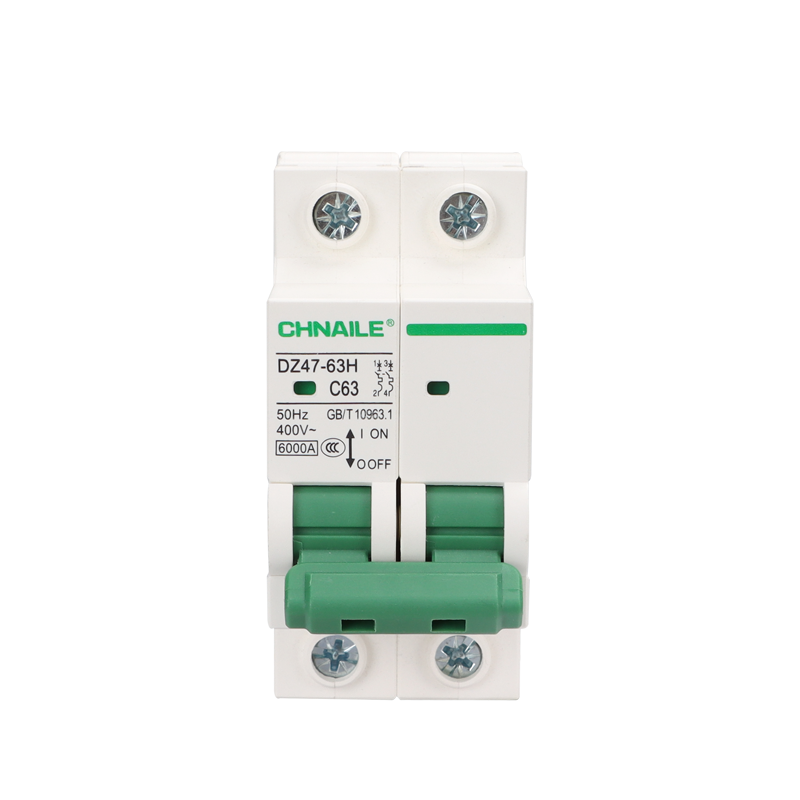
Reading the DZ47-63H's label systematically from the product image: the Type C characteristic at 63 A encodes the instantaneous release band of 5 to 10 times In — actuating between 315 A and 630 A — calibrated for the general-purpose load mix of commercial building tenant distribution circuits, small office building main sub-boards, residential apartment panel incomers, and the AC output protection circuits of small string inverters in rooftop PV installations. The 400 V~ working voltage at 50 Hz establishes the device's operational calibration for TN-S three-phase four-wire networks — the dominant distribution architecture across mainland China, across Chinese-standard export markets, and across the IEC-format markets of the Gulf, East Africa, and South Asia that overlap with the GB-standard Belt & Road procurement zone. The 6000 A breaking capacity positions the DZ47-63H correctly for the final-circuit and sub-incomer protection tier of commercial building and residential distribution boards fed through distribution transformers whose secondary impedance, combined with the distribution cable run to the panel, attenuates the available fault current to a level safely within the 6 kA envelope — the arithmetic that a protection coordination engineer performs when matching the breaking capacity specification to the network topology, and that government building inspectors reviewing a panel's short-circuit coordination study will verify as a first-tier compliance checkpoint.
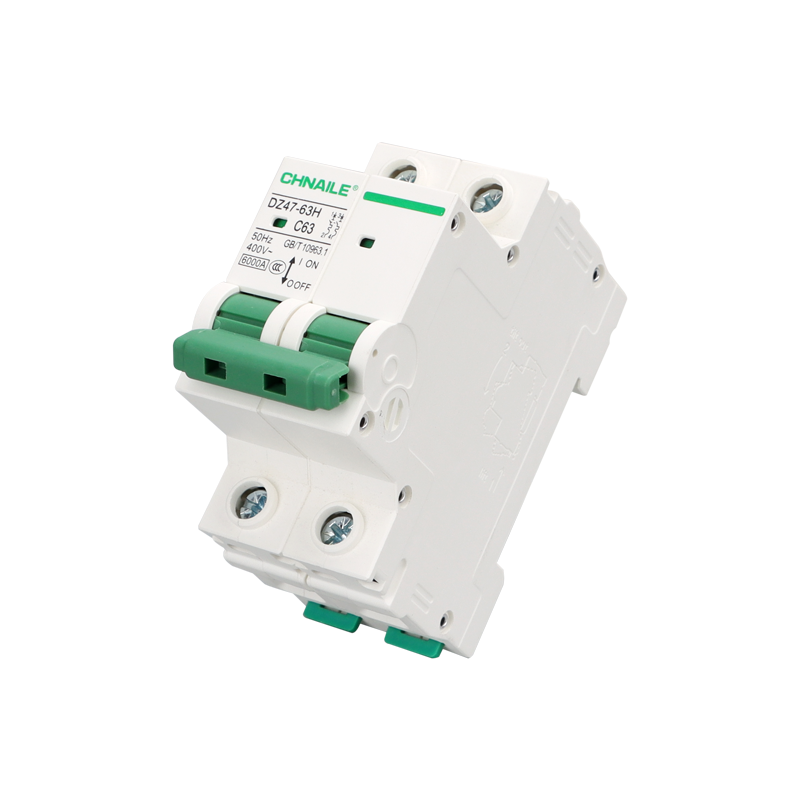
The most structurally distinctive visual characteristic of the DZ47-63H observed in the product image — when compared with the two-pole BD1-63S C32 documented in a preceding product page — is the single unified wide-span toggle handle that bridges both poles in a single continuous moulded actuator extending the full width of the two-module housing. Where the BD1-63S employs two independent toggle handles (one per pole, each occupying its own housing channel and separated by the central housing divider), the DZ47-63H employs a single actuator that mechanically couples both poles through the handle geometry itself rather than through an internal crossbar mechanism alone. This design choice produces three measurable operational consequences that experienced panel builders and commissioning engineers recognise as differentiating quality signals. First, the unified handle provides a larger contact surface area for the operator's grip during manual on/off switching — a practical advantage in the dense DIN rail environment of a fully populated residential or commercial sub-distribution board where adjacent devices leave limited clearance for fingertip access to narrow individual handles, reducing the risk of inadvertent actuation of an adjacent breaker during switching of the target device. Second, the wider handle span makes the I·ON (up) and O·OFF (down) position reading unambiguous at panel-door viewing distance without requiring the operator to lean in and read the small position legend text — the handle's physical displacement between the on and off positions is proportionally greater relative to the housing width when the actuator spans the full two-module width than when it occupies only a single-module width, making the trip state readable as a position rather than a label. Third, the handle geometry serves as a panel visual identity marker: in a residential or commercial distribution board populated with DZ47-series breakers, the repeating pattern of wide unified green handles creates a visual regularity that communicates design consistency and product family coherence — a factor that end clients and building inspectors perceive as a quality signal about the panel builder's attention to specification discipline, and that contributes to the panel's perceived value relative to a competing product assembled from mixed-family components with inconsistent toggle profiles. The green colour of the unified handle — matching the CHNAILE brand's signature colour visible in the logo typography on the label — creates an internal brand consistency that, under OEM private-label supply arrangements, is transferable to the panel builder's own brand identity: a panel builder who specifies their handle colour as a proprietary shade can, through our injection moulding colour compound specification, produce a DZ47-format MCB whose toggle handle colour is distinctively theirs and whose visual differentiation from generic market equivalents is immediately legible to the building inspector, the facilities manager, and the end client examining the installed board.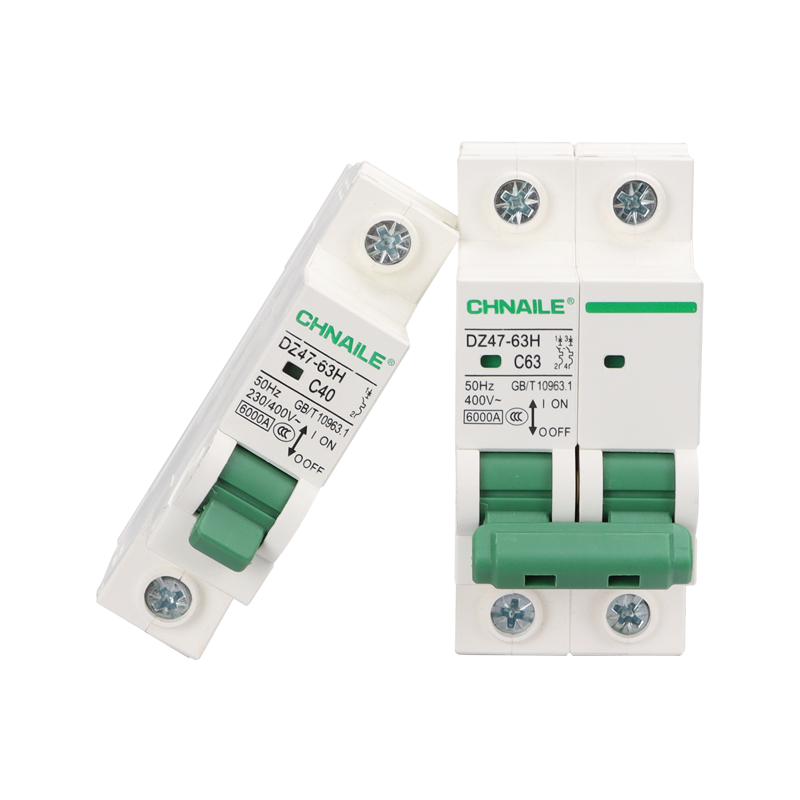
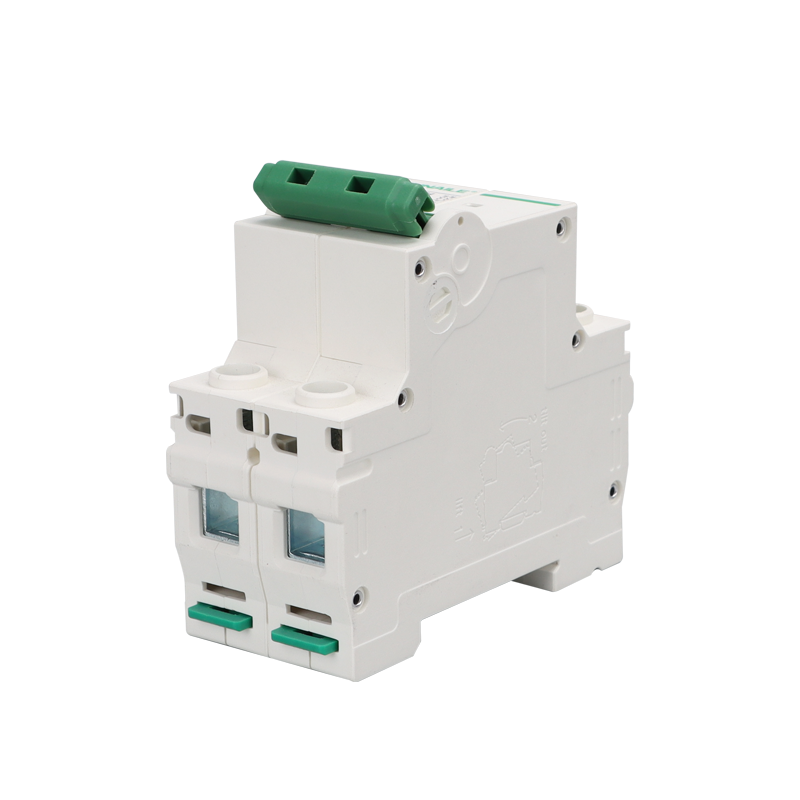
The dual circular raised terminal guard collars at both the line and load terminal faces — observable in the image as raised ring structures surrounding each of the four terminal screws — perform a panel assembly workflow function that is specific to the higher-current (63 A) end of the DZ47 range: at 63 A, the minimum conductor size for a correctly specified final circuit approaches 16 mm² cross-section (depending on installation method and cable rating per the relevant wiring rules), and the terminal collar's internal diameter is sized to guide the stripped end of a 16 mm² conductor into the terminal cavity without requiring the installer to manually align the conductor tip against the terminal aperture under the difficult working conditions of a densely wired panel interior. This guided-entry geometry reduces the installation time per conductor and the risk of insulation damage at the terminal entry point — a damage mode that can produce a partial-discharge site on the cable insulation that develops into an insulation failure over years of thermal cycling, and whose prevention by good terminal design is preferable to its detection by a post-installation insulation resistance test that may not reveal incipient damage at commissioning voltage levels.
The panel builder or switchgear integrator who maintains a qualified supplier relationship with a source factory capable of delivering both GB/T 10963.1 / CCC certified MCBs (the DZ47-63H platform) and IEC 60898-1 / CE certified MCBs (the BD1-63S platform) from the same manufacturing facility is, from a supply chain risk management perspective, holding a project portfolio hedge that their single-standard competitors cannot access. When a project's certification requirement changes during the procurement phase — as frequently occurs when a Chinese EPC sub-contracting arrangement on a mixed-standard project renegotiates the electrical component specification from IEC to GB, or vice versa, in response to end-client or local authority review — a supplier who can switch the MCB specification between certification pathways without changing the factory relationship, the shipment logistics, or the quality documentation management process preserves the panel builder's delivery schedule and avoids the vendor re-qualification cost and lead time that a specification change would otherwise impose. Our manufacturing facility operates both the GB/T 10963.1 production and type-test compliance infrastructure (supporting CCC mark issuance through the CNCA-authorised certification body process) and the IEC 60898-1 production and type-test compliance infrastructure (supporting CE marking and CB Scheme certification), within the same factory boundary and under the same quality management system — a dual-standard manufacturing capability that our OEM customers leverage by maintaining a single approved-supplier relationship that covers both certification pathways without requiring separate factory qualification audits for each standard. The rated current configurability from 6 A through 63 A within the DZ47-63H frame, combined with the 1P through 4P pole count availability, means that a panel builder qualifying our DZ47 platform qualifies the complete MCB population of a GB-standard distribution board design — every current rating from the 6 A lighting circuit through the 63 A sub-board incomer, every pole count from the single-pole tenant circuit breaker through the four-pole three-phase-plus-neutral sub-incomer — from a single qualification exercise whose documentation, audit, and administrative cost is identical whether it covers two SKUs or twenty. The housing colour, toggle handle shade, label content, and retail or project-quantity packaging are all configurable to the OEM customer's brand specification, allowing a panel builder whose brand is building recognition in GB-standard markets — through repeated visibility on Chinese EPC projects, through supply to Chinese-invested commercial real estate developments, or through domestic sales in markets where GB standards have been formally adopted as the national electrical code — to present a consistent branded product regardless of whether the underlying certification pathway is GB/T or IEC. Panel builders, switchgear integrators, electrical product distributors serving Belt & Road project supply chains, and procurement managers coordinating MCB sourcing across mixed-standard project portfolios are encouraged to initiate a direct technical dialogue with our manufacturing team via WhatsApp at +86 15985210820, where current rating, pole configuration, certification pathway, housing colour, label specification, and project volume requirements will be addressed by a bilingual export applications engineer returning a complete technical and commercial proposal within one working day.


