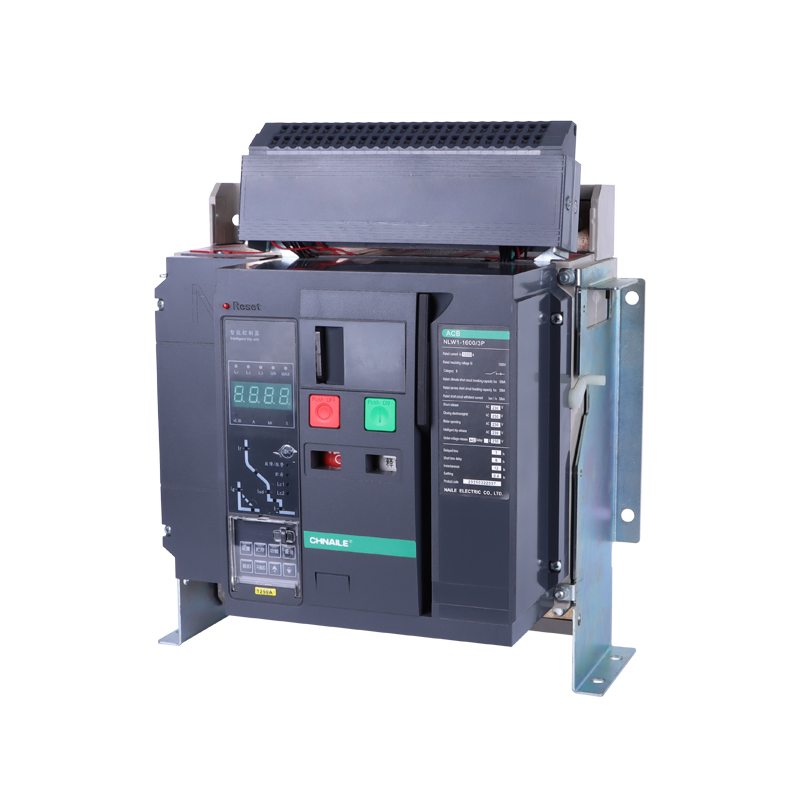
Nale Electric is willing to work together with domestic and foreign merchants to create brilliance!

Views: 0 Author: Site Editor Publish Time: 2026-10-11 Origin: Site
Low-voltage distribution networks rely on robust protection devices to prevent catastrophic failures. The DW45 1600A Air Circuit Breaker (ACB) serves as this critical primary defense. You will find it deployed across industrial applications and standard 400V/690V grids. It isolates faults rapidly and protects expensive downstream infrastructure.
Selecting an ACB at this specific amperage is rarely a simple task. Engineers must balance precise technical specifications against strict project budgets. You have to evaluate breaking capacities and tripping curves carefully. Furthermore, you must consider long-term maintenance requirements to ensure reliable operation. Over-engineering leads to wasted capital. Conversely, under-specifying compromises facility safety and operational uptime.
This guide provides engineers and procurement teams with a clear, evidence-based framework. You will learn how to evaluate, specify, and source the right DW45 1600A units. We explore physical configurations, intelligent controllers, and key procurement drivers. By applying these insights, you can secure optimal facility protection without overcomplicating your switchgear panels.
Performance Baseline: Standard DW45 1600A units must meet strict IEC 60947-2 standards, with critical distinctions in ultimate (Icu) and service (Ics) short-circuit breaking capacities.
Installation Strategy: The choice between fixed and draw-out types directly impacts upfront costs, panel footprint, and future maintenance downtime.
Intelligent Protection: Modern procurement requires assessing the exact tier of intelligent controller needed (from basic LSI protection to advanced communication modules for smart grids).
Cost Drivers: Pricing fluctuates heavily based on pole configuration (3P vs. 4P), controller complexity, and auxiliary accessory integration.
Establishing a rigid operational baseline ensures your circuit breaker performs reliably under stress. The DW45 1600A Air Circuit Breaker requires precise parameter matching to function correctly.
Continuous operational current (In) defines the breaker's everyday carrying capacity. A standard DW45 unit carries 1600A safely at an ambient temperature of 40°C. However, ambient temperatures inside crowded switchgear rooms frequently exceed this baseline. When temperatures rise, you must apply derating factors. For example, operating at 50°C might reduce the safe continuous current to 1500A. Ignoring thermal derating curves leads to nuisance tripping and premature contact degradation.
Rated operational voltage (Ue) typically spans 400V and 690V in industrial networks. You must also evaluate the rated insulation voltage (Ui). A robust Ui rating, often 1000V, guarantees the internal dielectric materials can withstand transient voltage spikes without flashing over.
Breaking capacity dictates how safely the breaker extinguishes a catastrophic fault arc. We look at three primary metrics.
First, consider the Ultimate Short-Circuit Breaking Capacity (Icu). For 1600A applications, grid fault levels typically demand an Icu between 80kA and 100kA. The breaker can successfully interrupt this fault level once without exploding.
Second, evaluate the Service Short-Circuit Breaking Capacity (Ics). This is arguably more critical for facility uptime. Ics represents the fault current the breaker can interrupt and still remain fully functional for immediate reset. Standard practice dictates specifying an Ics equal to 100% Icu. In tighter budgets, an Ics of 80% Icu remains acceptable. High Ics values guarantee you can safely restore power after a fault clears.
Third, assess the Rated Short-Time Withstand Current (Icw). This parameter is vital for time-delay coordination in multi-tier distribution networks. An Icw of 65kA for 1 second allows the main breaker to hold the fault while a downstream breaker clears the localized short. This prevents total facility blackouts.
Selecting between 3-pole and 4-pole designs depends entirely on your earthing system. Engineers specify 3-pole configurations for TN-C systems where the neutral and protective earth share a common conductor. 3-pole units cost less and occupy less space.
Conversely, 4-pole designs isolate the neutral phase completely. We mandate 4-pole breakers for TN-S and TT grounding systems. Disconnecting the neutral prevents dangerous feedback loops during maintenance. 4-pole breakers also provide enhanced safety in environments heavily populated by unbalanced single-phase loads or harmonic distortion.
Table 1: Standard Electrical Parameters Reference
Parameter | Description | Typical 1600A Value |
|---|---|---|
In | Continuous Operational Current | 1600A (at 40°C) |
Ue | Rated Operational Voltage | 400V / 690V AC |
Ui | Rated Insulation Voltage | 1000V |
Icu | Ultimate Breaking Capacity | 80kA - 100kA |
Ics | Service Breaking Capacity | 80% - 100% of Icu |
Icw | Short-Time Withstand Current | 65kA (1 second) |
The physical installation method you choose shapes the entire lifecycle of the switchgear. Buyers must weigh upfront capital against future operational flexibility.
Fixed configuration breakers bolt directly onto the copper busbars inside the panel. This design offers distinct structural advantages.
The primary pros include lower initial capital expenditure and a noticeably smaller physical footprint. Without the sliding chassis mechanism, fixed breakers contain fewer moving parts. This simplicity inherently lowers the risk of mechanical alignment failures over decades of use.
However, the cons are significant during maintenance events. Replacing or servicing a fixed breaker requires a complete panel shutdown. Technicians must manually unbolt live busbar connections. This process demands hours of highly skilled labor and extended facility downtime.
Fixed units are best for standalone machinery. They also suit facilities where extended maintenance windows are acceptable and budget constraints are tight.
A draw-out configuration mounts the breaker body onto a separate sliding chassis. The chassis remains permanently wired to the panel busbars.
The operational pros are tremendous. Technicians can crank the breaker out of the live panel in minutes. You avoid dismantling heavy busbars. Furthermore, draw-out units feature a dedicated "test" position. Here, the control circuits remain active while the main power contacts disconnect. This enables safe, realistic testing of the protection relays without energizing the downstream load.
The cons center around initial investment. Draw-out models demand higher upfront costs. They also require deeper switchgear panels. Installers must execute precise rail alignment during assembly to ensure the breaker seats correctly against the primary contacts.
We recommend draw-out configurations for data centers, hospitals, and continuous manufacturing plants. In these environments, minimizing shutdown time justifies the higher initial expenditure.
Configuration Comparison Chart
Feature | Fixed Type | Draw-Out Type |
|---|---|---|
Upfront Cost | Lower | Higher (includes chassis) |
Panel Footprint | Compact | Requires greater depth |
Maintenance Speed | Slow (Hours) | Fast (Minutes) |
Test Position | Not Available | Available (Safe testing) |
Ideal Application | Commercial buildings, standalone panels | Data centers, critical infrastructure |
The mechanical frame of an ACB handles the brute force of a short circuit. However, the intelligent controller acts as the brain. Modern procurement requires analyzing exactly how much intelligence your application actually needs.
Buyers often make the mistake of over-specifying controllers. A basic Electronic Trip Unit (ETU) provides reliable protection for standard distribution panels. It uses simple analog dials to set trip thresholds. It is highly durable and cost-effective.
Conversely, microprocessor-based intelligent controllers become mandatory in complex grid architectures. They offer digital precision, fault history logging, and real-time metering. Evaluate your panel requirements carefully before paying a premium for advanced relays you may never utilize.
Any reliable intelligent controller must offer precise curve adjustments. The standard protection suite is known as LSI or LSIG.
Long-time delay (Overload): Protects against sustained currents slightly above the rated load. The breaker waits before tripping to allow temporary safe surges, like motor startups.
Short-time delay: Handles moderate short circuits. It includes an intentional time delay. This delay provides downstream breakers the opportunity to clear the fault first, ensuring excellent system coordination.
Instantaneous: Reacts to severe, catastrophic short circuits. The breaker trips immediately without intentional delay to prevent equipment destruction.
Ground fault protection (G): Detects low-level leakage currents escaping to earth. While optional, specific regional compliance codes mandate it for fire prevention.
Smart grids demand constant data flow. Modern advanced controllers support extensive remote monitoring.
You must assess the need for communication protocols. Facilities often integrate these breakers into building management systems using Modbus RTU, Profibus, or standard RS485 interfaces. This connectivity allows operators to monitor phase currents remotely and trigger open/close commands from a central control room.
Additionally, discuss LCD display utility with your vendors. A clear localized display helps technicians diagnose faults instantly. They can read real-time voltage, current, and historical trip logs directly on the panel front, dramatically reducing troubleshooting time.
Procuring an ACB involves validating its long-term durability. Certifications and modular add-ons play a major role in how the breaker performs over its intended twenty-year lifespan.
Safety compliance is non-negotiable. Every procured unit must verify compliance with IEC 60947-2. This international standard dictates stringent testing for low-voltage switchgear.
Beyond IEC, verify regional certifications based on your installation site. European markets demand CE marking. Global projects often require CB scheme test reports. If you export panels to North American jurisdictions, the breaker must carry UL listings and meet NEC requirements. Missing these marks delays project commissioning.
Engineers must establish realistic expectations for lifecycle operations. Breakers degrade differently under load versus without load.
Mechanical endurance refers to operating the breaker without active current flowing. A high-quality DW45 1600A should achieve around 10,000 mechanical cycles before requiring major overhaul. Electrical endurance is much lower because breaking live arcs vaporizes contact material. Expect a standard rating of 2,000 electrical cycles under full load. Monitoring these cycles helps schedule predictive maintenance effectively.
Accessories transform a manual breaker into an automated protection node. You must evaluate several necessary add-ons during the specification phase.
Shunt releases: Enable remote tripping of the breaker via a voltage pulse from a remote push-button or PLC.
Undervoltage releases (UVR): Automatically trip the breaker if the supply voltage drops below a safe threshold, protecting sensitive motors from brownouts.
Motor operators: Electrically charge the closing springs. This facilitates remote switching and automatic transfer switch (ATS) operations.
Auxiliary feedback contacts: Provide open/closed status signals back to a SCADA system. They are vital for automated facility monitoring.
Highlight the importance of modular accessories. Easy-to-install snap-on modules reduce assembly time for panel builders. They also simplify field replacements if an accessory fails years later.
Navigating the procurement phase demands a structured approach. Understanding how manufacturers price these units prevents budget overruns.
The base price of a 1600A Air Circuit Breaker only tells half the story. Several factors heavily impact the final quote you receive.
First, breaking capacity tier dictates cost. Moving from an 80kA to a 100kA Icu requires heavier copper contacts and stronger arc chutes, raising the price. Second, draw-out chassis inclusion adds significant cost due to the complex mechanical sliding rails. Third, upgrading from a basic ETU to an advanced intelligent controller with RS485 communication adds a premium. Finally, integrating motor operating mechanisms and multiple shunt releases increases the final line item.
Why does manufacturing region matter? Global supply chains heavily favor established manufacturing hubs like Zhejiang, China. These hubs offer mature supply chains for DW45 components. They produce high-quality copper forgings and reliable electronic relays at scale.
You must rigorously audit the supplier’s testing capabilities. Do they provide individual factory acceptance test (FAT) reports? Reputable manufacturers supply detailed FAT documents proving the breaker passed specific breaking capacity and controller accuracy tests before leaving the factory line. Never accept generic type-test certificates as a substitute for individual unit testing.
To ensure apples-to-apples vendor comparisons, use a standardized checklist when requesting a quote. Ambiguity leads to mismatched bids.
Specify Voltage: Clearly state 400V or 690V AC.
Specify Poles: Demand either 3-pole or 4-pole configurations.
Installation Type: State explicitly whether you need fixed or draw-out designs.
Controller Type: Define required protection (LSI vs LSIG) and necessary communication protocols.
Required Accessories: List out motor operators, shunt trips, and the exact quantity of auxiliary contacts needed.
The DW45 1600A is a highly customizable platform. It is absolutely not a one-size-fits-all commodity. Engineers must tailor its physical configuration and internal electronics to match specific facility constraints. We have established that intelligent controller selection and precise physical mounting heavily influence long-term reliability.
Successful procurement directly aligns the breaker’s capabilities with your facility's downtime tolerance. You must balance the robust grid architecture against your available budget. Standardizing your request process ensures you receive accurate, comparable quotes from reputable suppliers.
We strongly encourage buyers to collaborate early in the design phase. Consult directly with technical sales teams to discuss your unique requirements. Request detailed CAD drawings for seamless panel integration. By submitting your single-line diagrams upfront, you guarantee the final breaker configuration validates perfectly against your electrical network demands.
A: Continuous current capacity typically drops when ambient temperatures exceed the 40°C baseline. For every 5°C increase above 40°C, the current carrying capacity usually drops by 2-5%. You must consult the manufacturer's specific thermal derating curves to determine the exact safe operating current for environments reaching 50°C or 55°C.
A: Retrofitting a fixed unit into a draw-out configuration later is highly impractical and cost-prohibitive. The copper busbar designs and physical panel depths differ significantly between the two types. You must decisively choose the installation type during the initial panel design and engineering phase.
A: Differentiate these based on your network's calculated short-circuit fault level. Standard (M-type) capacities often cover 80kA faults, which suits most commercial grids. High (H-type) capacities, often 100kA or above, are strictly required near large utility transformers or heavy industrial load centers with massive fault potential.
A: Basic breaker configurations usually include standard auxiliary contacts, such as 4NO+4NC (Normally Open/Normally Closed). However, specialized alarm contacts or additional feedback modules for SCADA integration are not standard. You must specify these custom additions as separate line items during the ordering process.