Nale Electric is willing to work together with domestic and foreign merchants to create brilliance!

Views: 0 Author: Site Editor Publish Time: 2026-02-04 Origin: Site
The circuit breaker fails to trip when the system’s load goes beyond what the wires can safely handle.
Overheating wires may start a fire before the circuit breaker reacts.
You need to understand how a circuit breaker works to keep safety first in your home.
If you use a 30 amp breaker instead of a 20 amp breaker, wires can get too hot and may cause a fire.
Always use the right size breaker for the wire to keep things safe and stop fires.
A circuit breaker keeps your home safe by turning off power when there is too much electricity.
If you smell something burning or your breaker turns off a lot, you should call an electrician.
You need to follow the National Electrical Code (NEC) to stay safe and keep your insurance.
A circuit breaker is very important in your home's electrical system. It works like a guard that watches the electricity. When you turn on lights or use appliances, electricity moves through wires. The circuit breaker helps keep this flow safe.
Circuit Breaker: A device that can open and close a circuit by hand, and will open the circuit by itself if too much current flows, without hurting itself.
Think of a circuit breaker as a switch that shuts off power if something goes wrong. It keeps your home safe from problems like too much current or a short circuit. If you plug in too many things or a wire breaks, the circuit breaker stops the electricity. This helps stop fires and keeps wires from getting too hot.
Inside a circuit breaker, there are several important parts. Each part does a special job to keep your home safe:
Component | Description |
|---|---|
Frame | Gives strength and keeps electricity from hurting people or equipment. |
Operating mechanism | Lets you open and close the circuit breaker, and can work in two ways: over toggle or two-step stored energy. |
Contacts | Lets electricity flow when closed; opens or closes the circuit as the fixed contact moves. |
Arc extinguisher | Puts out an arc when contacts open, stopping electrical discharge. |
Trip Unit | Finds abnormal current during overloads or short circuits and opens the mechanism to protect the circuit. |
A circuit breaker looks for trouble in your electrical system. When it finds a problem, it acts quickly to keep you safe. Here is how a circuit breaker protects your home:
The circuit breaker finds a fault, often by heat or magnetism from electric current.
When a fault is found, the contacts open to break the circuit.
A spring or other stored energy is used to pull the contacts apart and stop the electricity.
You will see that a circuit breaker shuts off power if the current gets too high. When there is too much load, the circuit breaker trips to keep wires and devices safe. Inside, a spring-loaded part is triggered by extra current. This lets the spring go and trips the breaker, stopping the electricity.
A circuit breaker protects against two main dangers:
Short circuit: The breaker finds a sudden jump in current and trips right away to stop damage.
Overload: The breaker feels too much current for a while, gets hot, and trips to keep wires from overheating.
Using the right circuit breaker helps keep your home and everyone in it safe.
You must pick the right circuit breaker size for the wire and load. This is not just a rule. It is very important for safety. If the circuit breaker is too big for the wire, the wire can get too hot. Hot wires can cause fires inside walls.
Tip: Always look at the wire size before you pick a circuit breaker. The National Electric Code (NEC) says every device must have a label. The label shows the right breaker size and the lowest wire ampacity.
Here are some reasons to match the circuit breaker to the wire and load:
The wire gauge must match the circuit’s amperage rating. This stops wires from getting too hot.
Bigger wires are needed for higher amperage. This helps stop heat and fire.
The NEC says you must use the nameplate on equipment. It tells you the breaker size and wire ampacity.
Matching the circuit breaker and wire gauge keeps the current safe.
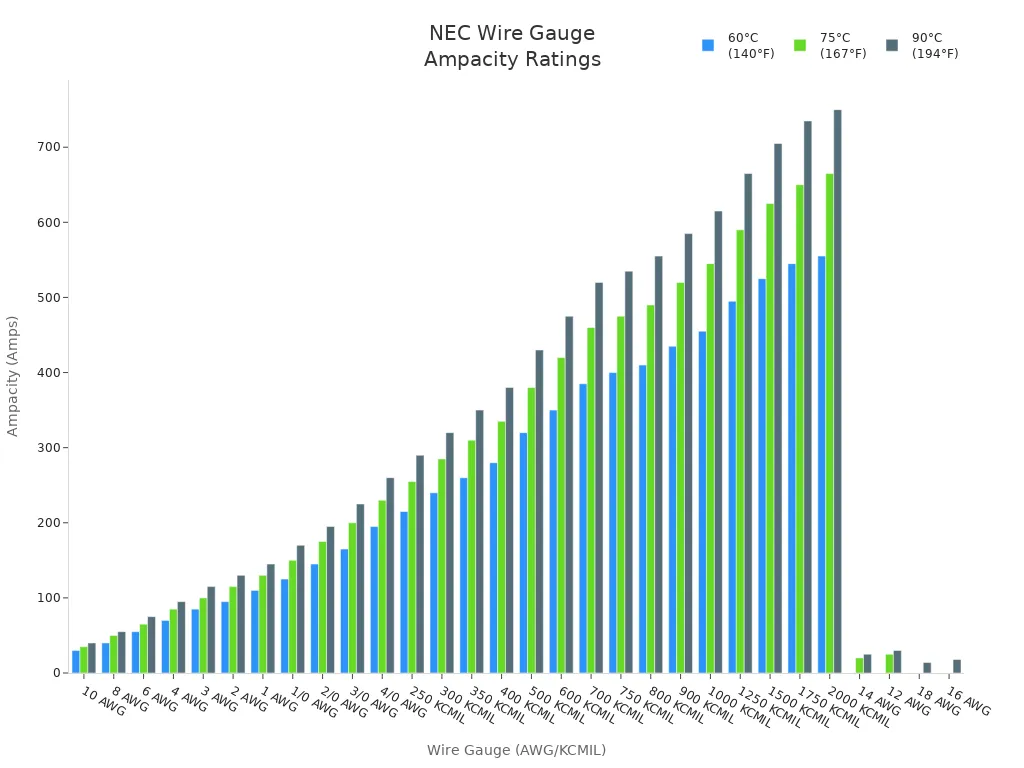
You can use this table to find the best ampacities for common wire gauges:
Wire Gauge (AWG) | 60°C (140°F) | 75°C (167°F) | 90°C (194°F) |
|---|---|---|---|
14 AWG | — | 20 | 25 |
12 AWG | — | 25 | 30 |
10 AWG | 30 | 35 | 40 |
8 AWG | 40 | 50 | 55 |
The circuit breaker pattern is a rule that helps keep circuits safe. You use this pattern to match the circuit breaker to the wire, the load, and the equipment. This pattern helps you avoid mistakes that can cause fires or damage.
You see the circuit breaker pattern in many places:
Hospitals use special circuit breakers for life-saving machines.
Office buildings use different circuit breakers for lights, computers, and air systems.
Farms use the circuit breaker pattern for big machines and motors.
Municipal buildings use the circuit breaker pattern for water pumps and other services.
Hotels use the circuit breaker pattern for high loads on every floor.
When you follow the circuit breaker pattern, you check the voltage and current ratings for each circuit. You also look at the Ampere Interrupting Capacity (AIC). This makes sure the circuit breaker can stop the biggest fault current. This is very important for places with big machines or lots of power.
In your home, you see the circuit breaker pattern in the way different breakers are used for different rooms and appliances. Most homes use a 15 amp circuit breaker with 14 AWG wire for lights and outlets. Kitchens and bathrooms use a 20 amp circuit breaker with 12 AWG wire for things like toasters and hair dryers.
Breaker Size | Usage Percentage | Primary Applications | Wire Gauge Required | Maximum Safe Load |
|---|---|---|---|---|
15 Amp | 35-40% | General lighting circuits, bedroom outlets, living room outlets | 14 AWG copper wire | 12 amps |
20 Amp | 25-30% | Kitchen counter outlets, bathroom outlets, laundry room circuits | 12 AWG copper wire | 16 amps |
You can use the circuit breaker pattern to make sure every circuit in your home has the right protection. This pattern keeps your home safe and helps you follow the rules.
If you use a 30 amp breaker on a 20 amp circuit, your home is in danger. The wires in your walls can only carry so much electricity. If too much electricity goes through, the wires get hot. Hot wires can get damaged and may start a fire.
Some common dangers from using a breaker that is too big are:
Wires get too hot from too much electricity
Junction boxes can break or spark
Outlets can melt and catch fire
Insulation can break down and cause short circuits
You might think a bigger breaker will fix tripping, but it does not. It only hides the real problem. Wires and outlets can get so hot that plastic melts or insulation burns. This can make sparks that start fires. Old electrical panels make this risk even worse. They may not work well with new appliances. You might see breakers trip often. Some people put in a bigger breaker to stop this, but it makes fires more likely.
Always use the right breaker size for the wire and devices. This keeps wires cool and your home safe.
Using a breaker that is too big is not just risky for fires. It also breaks important electrical codes. The National Electrical Code (NEC) has rules to keep you safe. If you use a breaker that is too large for the wire, you break these rules.
If you change panels the wrong way: People who are annoyed by a breaker that trips a lot may quickly put in a bigger breaker. This is very dangerous and also illegal. Wrong panels break the rules and are not allowed.
Insurance companies care about these rules. They want your electrical system to be safe before giving you coverage. If a fire starts because of a big breaker, your claim may not be paid. Insurance companies often check for problems like overloaded circuits or bad installations. If your system passes inspection and follows the rules, you may get better insurance rates.
Here are some common reasons people use breakers that are too big:
Too many high-power devices used at once
Wires touch and cause a surge called a short circuit
Ground faults, especially in wet places like kitchens or bathrooms
Old panels that cannot handle new devices
You can avoid these problems by following the rules and using the right breaker size. This keeps your home safe, your insurance valid, and protects you.
You can keep your home safe by making smart choices at the circuit breaker panel. Start by checking the size of your circuit breakers and the wires they protect. Use these steps to guide you:
Turn off all branch circuit breakers before you open the panel.
Shut off the main breaker to cut power to the entire circuit breaker panel.
Use a voltage tester or multimeter to confirm that no electricity is present.
Remove the panel cover with care. This step can be dangerous, so always stay alert.
Look at the wires connected to each breaker. Check the wire gauge by reading the numbers on the wire or comparing it to a chart.
Match the breaker size to the wire gauge. For example, use a 20-amp breaker with 12 AWG wire.
Tip: Never assume a breaker is off. Always test for voltage before touching any wires.
When you replace a breaker, follow these safety rules:
De-energize the circuit before starting.
Wear personal protective equipment like gloves and safety glasses.
Use only breakers that match the make and model of your panel.
Make sure the new breaker is certified by safety organizations such as UL.
Many homeowners make mistakes by choosing the wrong size breaker or ignoring signs of trouble. If you see scorch marks, hear buzzing, or smell burning, do not try to fix it yourself.
Some problems at the circuit breaker panel need expert help. Call a licensed electrician if you notice any of these warning signs:
Burning smell, smoke, or scorch marks near the panel
Sparks, buzzing, or crackling sounds
Warm outlets, switches, or a warm panel
Frequent breaker trips or loss of power in parts of your home
Shocks or tingles when touching appliances or outlets
Water near any electrical parts
Trying to fix these issues yourself can lead to electric shock, fire, or code violations. Electricians know how to follow the National Electrical Code and test your system after repairs. They keep your home safe and make sure your insurance stays valid.
You keep your home and family safe by using the right circuit breaker size. If you take shortcuts with electrical work, you can have big problems.
Fire risk goes up if you use the wrong breaker size. Loose connections cause many home electrical fires.
Appliances can break faster if voltage drops. This means you spend more money.
Insurance may not pay if your system is not safe.
Putting in a bigger breaker to stop tripping is very risky. Wires can get too hot and start a fire inside your walls.
If you are not sure about breaker size or safety, call a licensed electrician.
You risk failure of your wiring and devices. The wires can overheat before the breaker trips. This can cause a fire. You may not see a failure message, but the danger is real. Always match the breaker size to the wire.
No. A breaker can stop many types of failure, but not all. Some failures, like transient faults, may not trip the breaker. You need to check your system for signs of failure. If you see or smell trouble, call an electrician.
Transient faults are short bursts of abnormal current. You may see lights flicker or devices shut off. These faults can cause failure in your system if they happen often. Breakers may not always trip for transient faults, so watch for repeated problems.
You may notice frequent power loss, burning smells, or a breaker that will not reset. These signs point to failure. Sometimes, a breaker fails quietly. If you suspect failure, replace the breaker or call a professional.
Yes. A ground fault circuit interrupter protects you from shock and failure caused by ground faults. You should use one in kitchens, bathrooms, and outdoor areas. This device helps prevent failure and keeps your home safe.