Nale Electric is willing to work together with domestic and foreign merchants to create brilliance!

Views: 0 Author: Site Editor Publish Time: 2026-09-06 Origin: Site
Electrical engineers and facility managers constantly face a critical design dilemma. You must choose between the lower capital expenditure (CapEx) of a fixed configuration and the higher availability and safety features of a drawout design. Making the right choice directly impacts your operational success. This decision ultimately depends on minimizing Mean Time To Recovery (MTTR). You must effectively manage planned interventions while aligning seamlessly alongside strict facility uptime requirements. In this guide, we evaluate the fundamental physical design differences between both architectures. We explore operational safety mechanisms designed to protect your personnel. We also assess upfront expenses against downtime penalties. Finally, we break down integration constraints to guide your specification decisions. You will learn exactly how to balance budget limitations against structural operational resilience.
Operational Speed: A drawout air circuit breaker allows for rapid replacement without de-energizing the entire switchboard, drastically reducing facility downtime.
Initial vs. Lifecycle Cost: Fixed ACBs cost significantly less upfront but can incur higher operational expenses due to extended maintenance windows.
Safety Profile: Drawout designs offer distinct physical isolation positions (Connected, Test, Disconnected), reducing arc flash risks during testing.
Space & Integration: Fixed units require less footprint, but drawout units offer superior flexibility for future upgrades and standardized panel integration.
Understanding the core mechanical architecture is the first step in specifying the right breaker. Both types interrupt high fault currents efficiently. However, their physical mounting methods differ vastly.
A fixed ACB is permanently bolted directly to the switchgear busbars. Manufacturers design these units for static, long-term installations. They lack any integrated mobility mechanism.
Removal requires deliberate, manual unbolting of all primary power connections. Technicians must physically unfasten the heavy copper or aluminum bus links. This process necessitates a complete localized shutdown. You cannot safely remove this unit while the surrounding panel remains energized. Facility managers often specify this design for non-critical loads where scheduled downtime is acceptable.
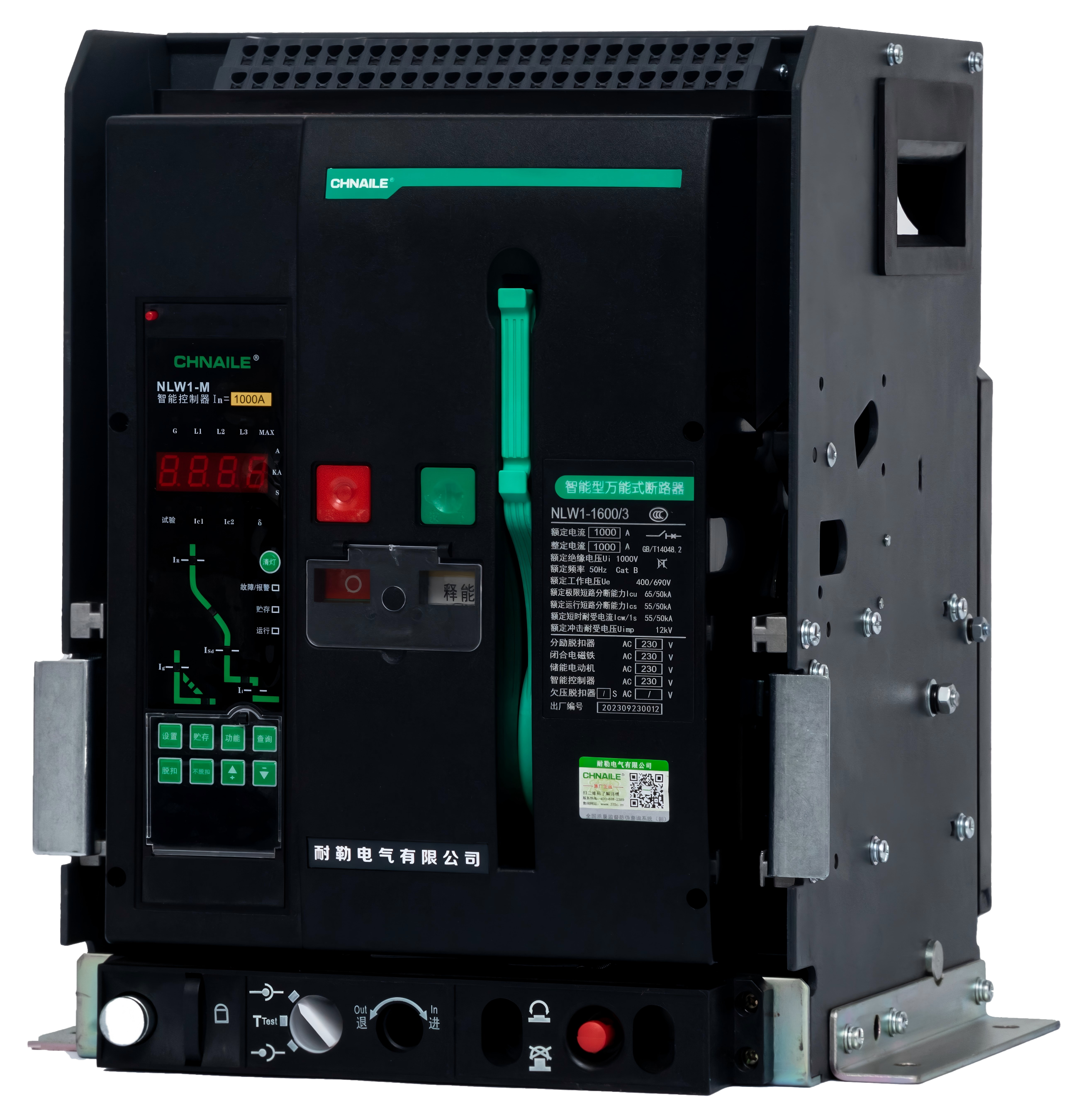
In contrast, a drawout system utilizes a sophisticated two-part design. It consists of a stationary cradle (often called a chassis) and a moving breaker unit. Panel builders wire the stationary cradle permanently to the main busbars. The active breaker then slides in and out of this cradle.
This design introduces the handcart breaker mechanism. Also known as a racking mechanism, it relies on an internal gearing system. Operators use a specialized handle to physically insert or extract the active unit. This mechanical leverage manages the heavy contact pressure required for high-amperage connections safely.
When reviewing manufacturer specification sheets, you will often see various terminology. Engineers use the terms "drawout" and withdrawable ACB interchangeably. Both terms describe this exact two-part chassis and moving breaker configuration.
Maintenance speed directly influences facility profitability. The operational workflow between these two designs impacts your Mean Time To Recovery (MTTR) significantly.
Evaluating the steps required to service each breaker reveals stark operational contrasts.
Fixed ACB Replacement Workflow:
Initiate a complete panel shutdown and verify isolation.
Apply complex Lockout/Tagout (LOTO) procedures to the main incoming bus.
Manually unbolt the phase connections using insulated tools.
Extract the heavy breaker using an external overhead hoist.
Install the new unit and re-torque all bus connections to precise manufacturer specifications.
This time-intensive process often takes several hours. It requires highly skilled labor and strict torque verification.
Drawout ACB Replacement Workflow:
Trip the breaker to open the contacts.
Engage the racking handle to rack the unit out to the disconnected position.
Remove the breaker from the chassis.
Insert a pre-tested spare unit and rack it back into the connected position.
This rapid swap process bypasses manual unbolting entirely.
A properly specified drawout air circuit breaker reduces MTTR from several hours down to mere minutes. This rapid recovery is a critical metric for continuous-process industries. Data centers, hospitals, and semiconductor fabrication plants simply cannot afford extended outages. In these environments, saving three hours of downtime easily justifies the higher initial equipment cost.
Annual switchgear maintenance looks completely different depending on your equipment. You can perform deep testing on withdrawable units offline. Technicians simply swap in a spare, keeping the load energized while they inspect the original breaker in a separate workshop. Conversely, fixed units force maintenance to occur entirely within the switchboard enclosure. This mandates a planned, facility-wide or localized outage.
Personnel safety during electrical maintenance is paramount. Advanced mechanical interlocks define the superiority of the drawout architecture.
Unlike stationary models, withdrawable systems offer three distinct mechanical positions. Each position serves a strict operational purpose.
Isolation States Overview
Position | Main Power Circuits | Control/Auxiliary Circuits | Operational Function |
|---|---|---|---|
Connected | Engaged | Engaged | Normal active operation. Load is fully energized. |
Test | Disconnected | Engaged | Allows operational testing of internal logic and tripping mechanisms without energizing the physical load. |
Disconnected / Isolated | Disconnected | Disconnected | Complete physical separation. Safe for full extraction and maintenance. |
Arc flash incidents remain a severe hazard in electrical rooms. The physical air gap achieved in the disconnected position provides visual confirmation of isolation. Operators can visually verify they are safe before inserting hands into the enclosure. This visual certainty significantly enhances operator confidence and complies with rigorous safety standards.
Common mistake to avoid: Never attempt to bypass mechanical position indicators. Always verify the physical indicator reads "Disconnected" before attempting to lift the breaker from its rails.
Drawout cradles feature built-in automatic safety shutters. When an operator racks the breaker out, heavy insulated shutters drop down instantly. They automatically cover the live, exposed busbars deep inside the chassis. This passive safety feature prevents accidental contact with energized components. This critical protection layer is completely absent in standard fixed setups, where removing the breaker leaves live busbars dangerously exposed.
Physical constraints within your electrical room heavily influence product selection. Engineers must calculate enclosure volumes carefully.
We must acknowledge the compact nature of fixed units. They eliminate the bulky outer chassis, making them inherently smaller. They are highly suitable for shallow enclosures or heavily constrained retrofit environments. If your electrical room lacks physical depth, a stationary model might be your only practical option.
Conversely, drawout cradles require significantly deeper enclosures. The switchgear must accommodate the chassis depth plus the mechanical clearance needed to extract the unit fully. Furthermore, the panel requires reinforced support structures to handle the dynamic weight shifting during the racking process.
Switchboard builders approach panel integration differently for both styles. Drawout chassis allow panel builders a massive scheduling advantage. They can install and pre-wire the stationary cradles long before the actual moving breaker units arrive. This parallel workflow accelerates site construction schedules.
However, implementation risks exist. What to watch out for: Precision is non-negotiable. Drawout installations demand exact alignment and perfect leveling. If the enclosure base is uneven, the chassis can twist slightly. This minor distortion causes the heavy racking mechanism to bind during insertion. Panel builders must ensure absolute structural rigidity to prevent operational failure.
Choosing between these two architectures requires a calculated approach. You must weigh upfront constraints against long-term operational demands.
Use the following logic rules to shortlist the correct breaker for your upcoming project.
Application Matrix
Decision Criteria | Specify Fixed ACBs | Specify Drawout ACBs |
|---|---|---|
Budget Constraints | Highly restricted capital budget. | Sufficient budget to prioritize uptime. |
Maintenance Outages | Facility has scheduled plant-wide annual shutdowns. | Hot-swapping or rapid replacement is mandated by SLA. |
Load Criticality | Non-critical loads (e.g., standard commercial lighting). | Mission-critical loads requiring N+1 redundancy. |
Space Availability | Highly restricted electrical room depth. | Adequate clearance for extraction hoists and racking. |
Safety Protocols | Standard LOTO procedures are acceptable. | Protocols demand visual isolation and automatic shutters. |
Specify Fixed ACBs When: Budget is tightly constrained and upfront cost reduction is the primary driver. They work perfectly when the facility already schedules annual plant-wide shutdowns. They serve non-critical loads reliably. They are also the best choice when floor space is highly restricted.
Specify Drawout ACBs When: The facility design requires strict N+1 redundancy. You should specify them immediately if the cost of one single hour of downtime exceeds the price delta of the breaker. They are mandatory when hot-swapping is required by Service Level Agreements (SLA). Finally, specify them when personnel safety protocols explicitly require distinct, isolated physical states before maintenance begins.
Neither breaker type is inherently superior across all applications. The specification choice is a mathematical calculation. You must weigh initial CapEx against the looming cost of downtime and maintenance labor. Fixed designs offer simplicity and space savings. Withdrawable designs deliver unparalleled safety, rapid recovery, and testing flexibility.
Before finalizing your electrical specifications, take action on these next steps:
Audit your facility's exact downtime tolerance in financial terms.
Review your switchgear enclosure depth constraints with your architectural team.
Assess your internal maintenance staff's capacity to handle manual hoist extractions.
Request comparative lifecycle labor models from your OEM or distributor to justify your final selection.
A: Generally, no. Converting it requires completely rebuilding the switchgear section to accommodate the new cradle, safety shutters, and racking mechanisms. The original busbar alignments will not match. It is far more cost-effective to specify the correct withdrawable type during your initial procurement phase.
A: No. The chassis design, mechanical interlocks, and racking alignments are highly proprietary to each manufacturer. You cannot safely insert a moving breaker from Brand A into a stationary cradle manufactured by Brand B.
A: Yes. While you perform the actual racking via a hand crank or motor, physical removal from the cradle requires assistance. High-amperage units carry significant weight. You will often need a specialized lifting truck or an integrated panel hoist to remove them safely.