Nale Electric is willing to work together with domestic and foreign merchants to create brilliance!


| Quantity: | |
The open-type knife switch's persistence as a standard isolation component in LV switchgear cabinets across commercial building main distribution boards, municipal substation LV panels, and industrial power distribution centres — despite the availability of enclosed disconnector and load-break switch alternatives — is explained not by inertia or cost pressure alone, but by a set of engineering and operational advantages that the open construction provides and that enclosed devices structurally cannot replicate. The most fundamental of these advantages is complete visual verification of isolation state: when the blade contacts of the open-type knife switch are in the open position, the physical absence of metal in the contact zone is directly observable by the maintenance technician preparing a permit-to-work, without requiring the technician to interpret an indicator lamp, a position sensor output, or a handle position that might not accurately represent the contact state if a mechanical defect has developed. The orange polymer operating bridge visible at the top of the device in the product image — whose vivid colour is the highest-contrast element of the assembly and is readable from several metres distance against the grey or black interior surfaces of a switchgear cabinet — provides the position indicator whose colour and geometry communicates the blade status to any observer in the cabinet's vicinity, satisfying the operational safety requirement for visible isolation that electrical safe-working procedures mandate without supplementary visual aids. The black spherical ball-grip handle mounted at the bridge's centre represents a handle geometry whose engineering rationale derives from biomechanics rather than convention: a spherical grip presents a contact surface that accommodates the palm-wrap grip used for both rotational actuation (turning the blade into and out of contact) and the vertical push-pull actuation used in some installation orientations, without requiring a tool-specific engagement geometry that would exclude maintenance personnel who do not carry the specific tool. The handle's black colour provides the visual contrast against the orange bridge that makes it the natural focal point of the maintenance technician's hand when reaching into the cabinet to actuate the disconnector, reducing the probability of unintended contact with adjacent components during the switching operation.

The two white ceramic insulating blocks — visible as the device's base structure, each block supporting approximately 1.5 poles of the three-pole assembly — are the dielectric backbone whose material selection determines the device's long-term insulation performance in the temperature-cycling, humidity-varying, and contamination-accumulating environment of an LV switchgear cabinet. Porcelain and steatite ceramics, the materials from which these blocks are conventionally manufactured, offer a combination of mechanical compressive strength, dimensional stability at temperatures from -40°C to +250°C, surface resistivity that is resistant to the tracking degradation that polymers exhibit after prolonged exposure to contamination under electrical stress, and a comparative tracking index (CTI) that satisfies the IEC 60112 classification for the highest-stress electrical positions in a low-voltage switchgear environment. The dimensional stability of ceramic under sustained load-bearing stress — its elastic modulus remains effectively constant across the operational temperature range, unlike the creep behaviour that polymer insulators exhibit under sustained compressive loading at elevated temperatures — ensures that the blade contact geometry, whose alignment with the spring-clip receptacles is determined by the precision of the blade pivot mounting in the ceramic bore, remains consistent across the device's service life without the contact force degradation that polymer creep produces in insulators of equivalent geometry. The two-block arrangement — each ceramic block serving a distinct functional zone of the three-pole assembly rather than a single monolithic base — allows the operating bridge mechanism to traverse between the two blocks without mechanical interference, and provides the installation flexibility of a compact footprint that accommodates the panel mounting bolt pattern of standard LV switchgear enclosures without requiring supplementary mounting adapters.
Parameter | Specification |
Pole Number | 3-Pole |
Brand | CHNAILE |
Control Type | Manual Toggle Operation |
Housing Material | Flame-retardant ABS Plastic |
Contact Material | Corrosion-resistant Copper-alloy |
Mounting Design | Pre-drilled Mounting Holes |
Customization Service | OEM/ODM Available |
The exposed spring-finger blade clip receptacles observable in the product image — the stainless or spring steel finger assemblies that grip the blade contacts and whose spring force maintains the contact pressure that determines the closed-position contact resistance — are the component whose accessibility in the open-type architecture produces the maintenance economy argument that justifies the open-type disconnector's continued specification in new switchgear assemblies despite the availability of enclosed alternatives. In an enclosed disconnector, contact degradation — spring relaxation, contact surface oxidation, debris accumulation in the contact zone — is not detectable by visual inspection without housing disassembly; the maintenance technician who suspects contact degradation based on thermal imaging anomalies or contact resistance measurements must remove the device from the panel and disassemble the housing before the contact surface condition can be assessed. In the open-type knife switch, the same assessment is performed by a visual inspection of the exposed spring fingers and blade faces, requiring no tools and consuming perhaps thirty seconds of maintenance time as part of the panel's routine annual infrared thermography inspection protocol. If contact surface cleaning or spring replacement is required, the open construction permits this intervention without device removal, restoring contact performance in a fraction of the time that an enclosed device's equivalent maintenance would require. For switchgear cabinets installed in commercial building electrical rooms, municipal pumping station switch rooms, and BESS container AC distribution panels — where the maintenance access scheduling is constrained by building occupancy, operational continuity requirements, and safety permit windows — the reduction of maintenance intervention time enabled by the open-type construction is a lifecycle cost advantage whose financial value, accumulated across a fifteen-year operational period, is substantially larger than the unit price premium that an enclosed disconnector of equivalent current rating might command.
The spring-finger clip geometry is calibrated at the point of manufacture to produce a contact pressure within the range that IEC 60947-3's closed-position contact resistance requirement specifies — a pressure that must be high enough to maintain the contact resistance below the value that would produce a temperature rise exceeding the standard's limit at rated current, and low enough to allow the blade to be inserted and withdrawn by the operating bridge mechanism without requiring a mechanical advantage tool. Our manufacturing process verifies this spring force calibration on a sample basis using calibrated force-displacement test equipment whose measurement traceability is maintained against our internal metrology standards, ensuring that the assembled device's contact force is within the design envelope that the type-test contact resistance measurements were obtained under.
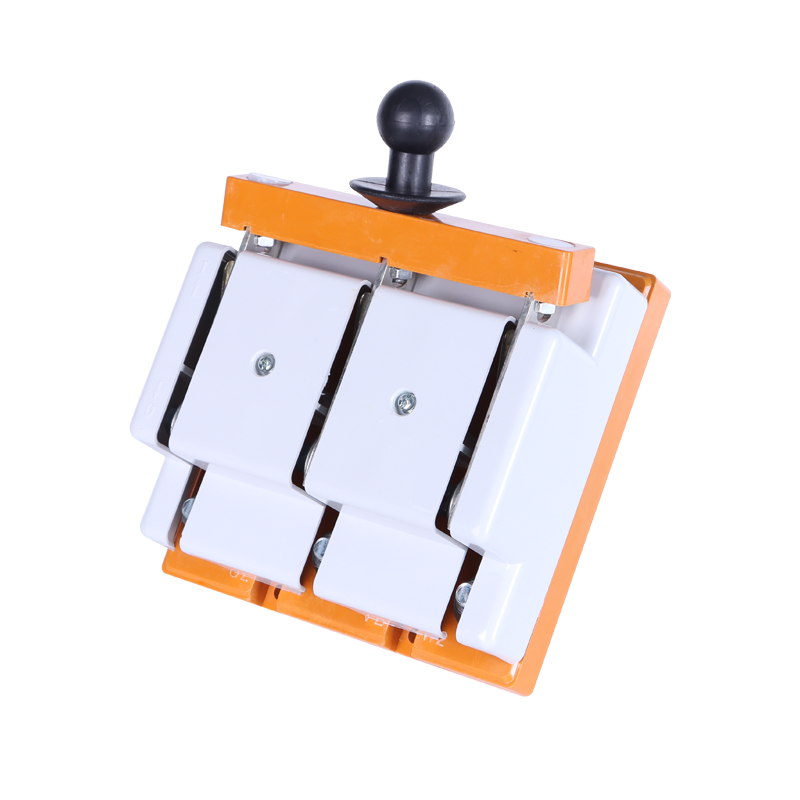
The panel bolt-mounting configuration of the open-type knife switch — with the two ceramic blocks providing the structural mounting interface through which the device is secured to the switchgear cabinet's mounting plate or bus support bracket — makes this device category the standard isolation element for the positions within LV switchgear cabinets where a visible-break isolator is required at the circuit level rather than at the main incomer level. In a commercial building LV main distribution board, visible-break isolation at the incomer position is typically provided by an ACB or MCCB with a defined open-contact gap; at the outgoing feeder positions, the panel builder may specify open-type knife switches as the circuit-level isolation elements whose visible-break function satisfies the IEC 60364-4-46 requirement for isolation capability without the additional cost of a fully enclosed load-break switch at every feeder position. The open knife switch at this position — between the bus bars and the outgoing feeder MCCB or fuse — provides the visible isolation point that enables maintenance work on the downstream feeder circuit without requiring the main incomer to be opened and the entire bus bar section to be de-energised. This selective isolation capability, which allows a facilities management team to isolate individual feeder circuits for maintenance without interrupting supply to other building zones, is one of the primary design arguments for including open knife switches at the feeder isolation tier of a commercial building main distribution board — an argument that the panel builder's technical sales team can present to the building developer's electrical consultant as a measurable improvement in the building's operational resilience compared to a simplified panel design that omits feeder-level isolation. For BESS container AC distribution panels, the open knife switch at the AC incomer isolation position provides the physical visible-break isolation that battery system safety protocols require before maintenance personnel enter the container to access the battery management system, the inverter modules, or the AC wiring infrastructure — a safety function whose operational regularity (the container may require maintenance visits at six-month intervals) justifies the selection of an open-type device whose maintenance inspection time is minimal over the enclosed alternative. The rated current configurability of our open knife switch platform — from the lighter-duty tier (63–100 A) appropriate for outgoing feeder isolation positions in commercial building distribution boards through the medium-duty range (160–400 A) appropriate for main incomer isolation in smaller commercial buildings and BESS container AC panels, to the heavy-duty tier (630–1000 A) appropriate for large building main distribution incomer positions — means that a single OEM relationship with our factory provides the panel builder with the full open knife switch population of their switchgear product range without requiring separate supplier qualifications for each current tier. The orange operating bridge colour is configurable for OEM customers whose panel colour coding convention specifies a different bridge colour to indicate circuit status or device category, with the polymer injection moulding process accommodating the colour change at the compound preparation stage. The pole count — standard 3P as shown, or 2P for single-phase isolation positions — and the handle format — spherical ball grip as shown, or alternative lever handle formats for panel mounting orientations where the spherical grip is ergonomically constrained — are both configurable at OEM order stage. Panel builders, switchgear integrators, commercial building EPC electrical contractors, BESS system electrical engineers, and municipal infrastructure procurement managers evaluating open-type knife switch disconnectors for isolation positions in LV switchgear assemblies are encouraged to initiate a direct technical dialogue with our manufacturing team via WhatsApp at +86 15985210820, where rated current, pole count, insulation material, operating handle format, and project volume parameters will be addressed by a dedicated export applications engineer returning a complete technical and commercial proposal within one working business day.


