Nale Electric is willing to work together with domestic and foreign merchants to create brilliance!


| Quantity: | |
The bottom-mounted electronic trip unit module visible in the product image — spanning the full width of the NLM1EL-800M's housing in a dedicated sub-assembly that is mechanically distinct from the main contact mechanism above it — is the functional element that separates this device from every thermal-magnetic MCCB in the NLM1 platform and repositions it within the protection engineering vocabulary that utility-grade substation designers and commercial building electrical consultants employ when specifying main incomer protection at the MV/LV transformer secondary. The seven rotary adjustment dials presented on the trip unit face — governing, from left to right, the long-time protection current Ir(A), the long-time protection delay Ir(s), the long-time protection thermal memory factor Ir×(Ir), the instantaneous overcurrent pickup Io(A), the short-time pickup current relative to Ir, the short-time delay Isw(A), and the short-time delay duration Isw(s) — implement the LSIG (Long-time, Short-time, Instantaneous, Ground-fault) four-function protection architecture through a continuously adjustable parameter matrix rather than the fixed, factory-calibrated thermal-magnetic characteristic of a conventional MCCB. The protection engineering consequence of this parameter matrix is that a single device can be configured, through the rotary dial adjustments and the Test button verification sequence, to serve as the main incomer protection for a 1600 kVA transformer feeding a commercial office tower (requiring a different Ir and Isw setting combination than a 2000 kVA transformer feeding a mixed-use retail development), or as the bus-coupler protection in a duplicate incomer switchboard configuration (where the Short-time delay must be set precisely to coordinate with the two incomer MCCBs' own Short-time characteristics to enable selective fault isolation). The Ir adjustable range of 630 A to 800 A within the 800 A frame reflects the protection engineer's requirement that the long-time pickup current be settable below the frame's maximum to match the transformer's secondary rated current — a requirement that a fixed-rated device at 800 A cannot satisfy for a 2000 kVA, 400 V transformer whose secondary current of 2887 A immediately indicates this device protects a different transformer size. The relationship between Ir and the transformer's rated secondary current determines the device's thermal protection accuracy: setting Ir too high relative to the transformer's rated current allows sustained overloads that accumulate transformer winding thermal stress without tripping; setting it too low causes nuisance trips during legitimate motor-start current surges on the secondary bus. The seven-dial architecture allows this relationship to be set with the precision that a commissioning engineer can verify against the protection coordination study's time-current coordination requirements, rather than accepting the nearest thermal calibration point available in a fixed-current thermal-magnetic device's product range.
Technical Parameters
| Device Category: | Electronic Molded Case Circuit Breaker (Smart MCCB) |
| Poles Configuration: | 3P (Simultaneous 3-Phase Intelligent Load Control) |
| Frame Size & Rated Current: | 800A Frame / Adjustable Ir1 (630A to 800A) |
| Trip Unit Technology: | Solid-State Microprocessor (True RMS sensing) |
| Protection Matrix: | Full LSIG (Long, Short, Instantaneous, Ground configurable) |
| Rated Operating Voltage (Ue): | AC 400V (50Hz) |
| Rated Insulation Voltage (Ui): | 1000V |
| Rated Impulse Withstand Voltage (Uimp): | 12kV (Extreme grid surge & lightning immunity) |
| Ultimate Breaking Capacity (Icu): | 65kA (M-Type Heavy-Duty Plasma Suppression) |
| Short-Time Withstand Current (Icw): | 10kA for 1s (Category B Elite Selectivity) |
| Standard Compliance: | GB/T 14048.2 / IEC 60947-2 |

The three LED status indicators — overload, pre-alarm, running — visible on the left section of the electronic trip unit face constitute a real-time protection status display whose operational value in a commercial building main switchroom context is the reduction of mean-time-to-diagnosis during sustained overload events that have not yet reached the trip threshold. In a thermal-magnetic MCCB, the first observable evidence that a sustained overload condition is developing is the trip event itself — there is no pre-trip warning, no intermediate status that allows the building's electrical engineer to identify and shed load before the incomer trips and interrupts supply to the entire building. The NLM1EL-800M's pre-alarm LED activates when the measured current exceeds the pre-alarm threshold (typically set at 80–90% of Ir) and the thermal accumulation in the trip unit's thermal memory register reaches a defined fraction of the trip threshold — providing a warning window during which the building management system operator or the facilities manager can shed controllable loads (non-essential HVAC zones, EV charging stations, amenity power) to prevent the trip, preserving the supply continuity whose interruption cost in a large commercial building during business hours is measured in thousands of dollars per hour in tenant contractual obligations, elevator entrapment incidents, and data system UPS transition events. The overload LED activates when the thermal accumulation crosses the trip preparation threshold but before the trip delay time has elapsed — a second-stage warning that the trip is imminent unless load reduction occurs within the remaining delay window. The running LED confirms that the trip unit is powered and functional during normal non-overloaded operation, providing the baseline status confirmation that a maintenance technician requires when clearing a panel alarm that has been generated by the pre-alarm LED: if the running LED is illuminated and the overload LED is dark, the pre-alarm condition has resolved without requiring human intervention, and the alarm can be cleared as a self-resolved transient event rather than a condition requiring investigation.

The certification architecture of the NLM1EL-800M/3300 — GB/T 14048.2 and IEC 60947-2 concurrent compliance, CB Scheme certification issued through a CNCA-IECEE accredited laboratory, and TUV third-party type-test report validation — is not, for the panel builder or switchgear integrator competing for infrastructure project contracts in the Middle East and Africa, merely a list of credentials that belongs on a product datasheet. It is a pre-qualification instrument whose structure and specificity determine whether a switchgear bid is accepted for technical evaluation or rejected at the document screening stage of a government or utility procurement process. The Gulf Cooperation Council's national electricity authorities — DEWA, SEC, ADDC, MEW Kuwait, and their equivalents — and the African utility procurement bodies — KPLC in Kenya, TANESCO in Tanzania, ZESCO in Zambia, NERC in Nigeria, and ESKOM in South Africa — have progressively tightened their equipment approval documentation requirements over the past decade, moving from acceptance of manufacturer's declarations of conformity toward mandatory submission of third-party type-test reports from laboratories whose IECEE accreditation can be verified against the IECEE CB Scheme's online certificate database. A switchgear delivery whose MCCB component is supported by a CB Scheme certificate — whose certificate number, issuing National Certification Body, and date of issue can be verified online by the utility's procurement department in real time — passes this first-tier documentation screening without the "additional evidence requested" response that an uncertified or self-declared device generates, a response that typically adds four to eight weeks to the equipment approval timeline and may, in competitive tender scenarios with fixed delivery milestones, result in disqualification of the tender rather than a documentation supplement. The TUV type-test report adds a second layer of independent technical authority whose name recognition among Middle Eastern and African utility engineers — who frequently have prior experience with European equipment standards through training programmes conducted by European manufacturers or through IEC technical assistance programmes — translates directly into accelerated technical review acceptance. A tender submission that names TUV as the type-test laboratory for the MCCB component communicates a level of testing rigour whose implied quality standard has been established through decades of global brand investment by the European certification authorities and does not require the utility's review committee to research the laboratory's accreditation status before accepting the report as technically authoritative.

Our factory's support infrastructure for the switchgear integrator navigating the government tender documentation process extends beyond the certification documents themselves to encompass document review support — where our technical documentation team prepares and customises the component specification sheets, type-test report extracts, and compliance declarations to match the specific document format and content requirements of the tender specification — and factory audit support, where we receive and host the procurement authority's or the EPC contractor's quality audit team at our manufacturing facility, providing the production records, process control documentation, and test equipment calibration certificates that the audit protocol requires. The factory audit support capability is particularly relevant for projects funded by the African Development Bank, the Islamic Development Bank, the Kuwait Fund for Arab Economic Development, and other multilateral lending institutions whose disbursement conditions include mandatory pre-shipment inspection and factory audit of electrical infrastructure equipment — audit conditions that, if the equipment supplier cannot accommodate the inspection timeline and access requirements, trigger equipment substitution requests that disrupt the project delivery schedule and generate contractual complications for the EPC contractor. The H-grade breaking capacity — Icu = 85 kA / Ics = 65 kA at 400 V, with the M-grade alternative at Icu = 65 kA / Ics = 50 kA — provides the panel builder with two distinct performance tier options within the same housing format, allowing a project specification that requires the higher breaking capacity (for the main incomer position of a substation fed by a large transformer) to be served from the H-grade variant while a budget-constrained project specification accepting M-grade performance at a lower unit cost is served from the M-grade variant, both from the same qualified supplier relationship and the same housing form factor that simplifies the panel enclosure design.
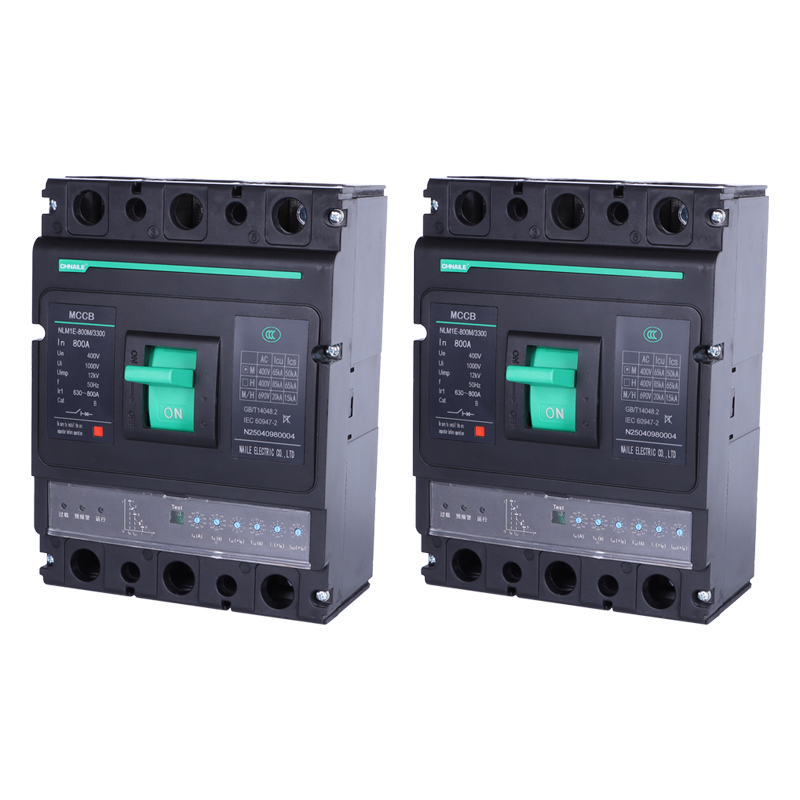
The NLM1EL-800M/3300's position as the 800 A frame representative of the NLM1E electronic trip platform — a platform whose frame series extends from the 160 A tier through 250 A, 400 A, 630 A, to the 800 A configuration reviewed here — creates a product consolidation opportunity for the switchgear integrator whose MDB and substation project BOM requires electronic trip MCCBs across multiple frame current tiers. A commercial district development project might simultaneously require 250 A electronic trip MCCBs for the sub-incomer positions of individual building distribution boards, 400 A electronic trip MCCBs for the main incomers of medium-sized buildings, 630 A MCCBs for the sub-incomer positions of the district's central electrical room, and 800 A MCCBs for the main incomer from the MV/LV transformer secondary — four frame sizes, all requiring LSIG protection, all requiring IEC 60947-2 certification, and all requiring the same CB Scheme and TUV documentation framework for the project's equipment approval submission. Sourcing all four frame sizes from a single NLM1E platform manufacturer consolidates these four qualification records, four documentation packages, and four delivery relationships into one, with the consistency of the electronic trip unit interface across all frames allowing the commissioning engineer to apply the same dial-setting procedure and the same Test button verification sequence across every MCCB position in the project — a commissioning efficiency whose labour-hour value, across a large multi-building district project with forty or fifty MCCB positions, is substantial. The Category B classification of the NLM1EL-800M — distinguished from Category A devices by the requirement to demonstrate recovery capability after short-circuit interruption through a mandatory recovery test sequence — reflects the device's engineering specification for positions where post-fault service restoration must be verified before re-energisation, consistent with the protection philosophy of main incomer and bus-coupler positions where an automatic reclose without contact inspection would be inappropriate. For the switchgear integrator developing a proprietary MCCB product line under their own brand — an increasingly viable commercial strategy for mid-to-large panel builders in Saudi Arabia, UAE, Nigeria, Kenya, and South Africa whose brand recognition in their domestic market allows a premium price point over generic imported devices — the NLM1E platform's OEM customisation architecture supports private-label face marking (brand designation, model series, rating plate content), housing colour reconfiguration from the standard black shown in the image to custom RAL references, and packaging format adaptation from individual carton to project-quantity bulk pack. The electronic trip unit's rotary dial configuration — which the commissioning engineer sets to project-specific values during installation — means that the OEM customer's brand name appears on the device face while the protection parameter flexibility that the LSIG architecture provides remains fully accessible to the end-client's protection engineer, creating a branded product that delivers the technical depth of an electronically tripped MCCB under the panel builder's own commercial identity. Switchgear integrators, panel builders, MV/LV substation switchgear assemblers, commercial building EPC electrical contractors, and infrastructure project procurement managers across the Middle East, Africa, and global markets who are evaluating the NLM1E electronic trip MCCB platform for main incomer, bus-coupler, or sub-incomer protection positions are encouraged to initiate a direct technical dialogue with our manufacturing team via WhatsApp at +86 15985210820, where frame current, breaking capacity grade, LSIG parameter range, pole count, housing colour, private-label specification, CB/TUV documentation package, factory audit scheduling, and project volume requirements will be addressed by a dedicated export applications engineer within one working business day.
Instruction Manual for Electronic Molded Case Circuit Breakers.pdf


