Nale Electric is willing to work together with domestic and foreign merchants to create brilliance!


| Quantity: | |
The residual current circuit breaker with integral overcurrent protection — the device category to which the NLB1D-80 belongs under IEC 61009-1 — occupies a structurally unique position in the low-voltage protection hierarchy precisely because it resolves, within a single two-module DIN rail housing, a protection coordination problem that the conventional combination of an upstream RCCB and a downstream MCB addresses only partially and at greater panel space cost. The fundamental engineering argument for the RCBO architecture begins with the observation that a circuit protected by an RCCB-plus-MCB combination provides residual current protection only at the RCCB tier: if a ground fault develops in the cable downstream of the MCB but upstream of the load, the MCB's overcurrent trip mechanism responds to the cable fault current while the RCCB monitors the imbalance between line and neutral currents at a point upstream of the fault — a geometry that, depending on the fault impedance and the MCB's trip characteristic, may result in the MCB tripping before the RCCB, leaving the residual current path unmonitored during the trip sequence. The RCBO eliminates this coordination ambiguity by integrating both detection mechanisms within the same device, measuring residual current at the same point in the circuit as the overcurrent element, so that both the thermal-magnetic trip (responding to sustained overcurrent or short-circuit conditions) and the residual current trip (responding to ground leakage exceeding IΔn = 30 mA) are monitoring the identical current path and will respond to any fault condition that activates either mechanism — with the whichever mechanism reaches its threshold first initiating contact separation, and the other mechanism resetting to standby as the fault current collapses following contact opening.
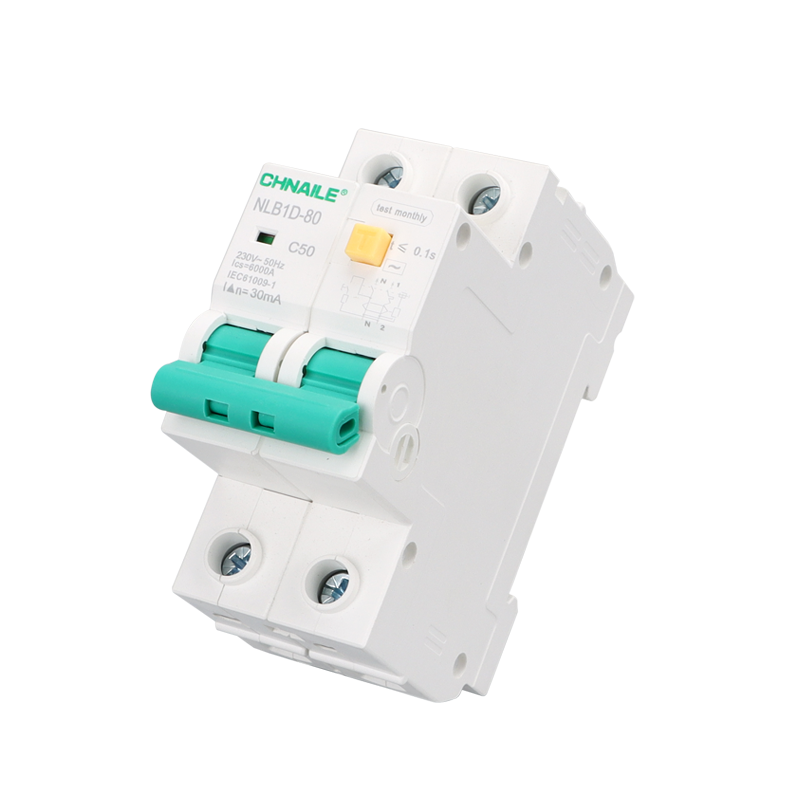
Reading the NLB1D-80's label in the product image with engineering precision: C50 designates a Type C characteristic at 50 A rated current, encoding the instantaneous release band of 5 to 10 × In — meaning the electromagnetic release activates between 250 A and 500 A, a window calibrated for the inrush currents produced by mixed resistive, inductive, and electronic loads characteristic of commercial building tenant circuits rather than the purely resistive loads of Type B or the high-inrush motor loads of Type D. 230 V~/50 Hz establishes the rated operational voltage and frequency, confirming the device's calibration for the dominant single-phase supply standard across Europe, the Gulf Cooperation Council, East Africa, South Asia, and the majority of the Southeast Asian markets where IEC-derived electrical installation codes govern. Ics = 6000 A specifies the conditional short-circuit current — the maximum prospective fault current the device is able to withstand, under the protection of an upstream backup protective device, without sustaining damage that impairs subsequent normal operation — distinguishing this parameter from Icn (the rated short-circuit capacity without backup protection), and placing the device correctly in the final-circuit tier of a coordinated LV protection system where an upstream MCCB limits the fault current presented to the RCBO to within its conditional withstand envelope. IΔn = 30 mA is the residual operating current threshold — the minimum ground leakage current that will produce trip actuation within the IEC 61009-1 time-current characteristic, and the sensitivity value that IEC 60364-4-41 identifies as the threshold below which the risk of cardiac fibrillation from sustained ground-contact current is considered acceptable for the general population, making 30 mA the universal personal protection sensitivity standard for final circuits in occupied commercial and residential buildings across all IEC-governed markets. The t ≤ 0.1 s response time marking, visible on the right face of the housing in the product image, confirms Type AC instantaneous response — the RCBO will open its contacts within 100 milliseconds of detecting a residual current exceeding IΔn, satisfying the IEC 60364-4-41 disconnection time requirement for final circuits at 230 V without the delay introduced by Type S (selective) devices, which are reserved for upstream positions in a coordinated RCCB cascade.
Parameter | Specification |
|---|---|
Model | NLB1D-80-C50 |
Pole configuration | 1P+N |
Rated current (In) | 50A |
Rated voltage (Ue) | AC 230V / 400V |
Rated residual operating current (IΔn) | 30mA |
Rated short-circuit breaking capacity (Icn) | 6kA |
Tripping curve | C-type (5-10 In) |
Rated frequency | 50/60 Hz |
Trip time (residual current) | < 0.1 s |
Mechanical endurance | 10,000 operations |
Electrical endurance | 4,000 operations |
 |  |
The yellow test button on the NLB1D-80's right face — positioned centrally in the upper housing section and immediately identifiable in the product image by its high-visibility amber colouring, which differentiates it visually from the green LED indicator and the teal toggle — is not merely a commissioning convenience; it is the physical interface for the periodic functional verification that IEC 61009-1 mandates as a maintenance requirement for all residual current devices, and whose execution is a precondition for the device's liability protection to remain valid under the installation's applicable electrical installation code. The printed strip reading "test monthly" — applied to the housing surface immediately above the test button and visible in the product image as a distinct label element — externalises this maintenance requirement in the language of an end-user reminder rather than an installation manual footnote, making the testing obligation legible to the building facilities manager, the property maintenance contractor, and the tenant's own staff without requiring them to retrieve or read the device's technical documentation. For panel builders whose post-sale warranty and liability exposure is governed by the terms of their supply contract with the building owner or the main contractor, the presence of this on-device maintenance reminder constitutes a documented communication of the testing requirement that the panel builder can reference in any dispute about whether the end user was informed of their maintenance obligation — a risk management function whose commercial value to the panel builder exceeds, by a significant margin, the incremental cost of the label printing operation. The test button operates by inserting a calibrated resistor across the line-to-neutral measurement path of the internal toroidal current transformer, creating an artificial imbalance current of nominally IΔn magnitude that exercises the full residual current detection and trip chain — from toroid output through signal processing to trip coil actuation and contact opening — without requiring the presence of an actual ground fault or the use of an external injection test set. A successful test actuation (contact opening, confirmed by the toggle moving to the tripped position and the green LED extinguishing) provides functional evidence that the detection chain is intact and the trip mechanism is operable, satisfying the IEC 61009-1 periodic verification requirement and providing the maintenance record entry that a building's electrical installation log must carry to demonstrate ongoing compliance. Our factory verifies the test button function on every unit during the post-assembly functional test sequence, confirming both that the test actuation produces contact opening within the rated response time and that the device resets correctly following manual re-closure of the toggle — a two-stage verification that ensures the unit delivered to the panel builder is not merely mechanically complete but functionally exercised.
The configuration portfolio anchored by the 1P+N device shown — extending to 3P+N for three-phase applications — covers the complete residual current protection requirement matrix of the commercial building and infrastructure panel builder's project portfolio in a manner that a single-pole RCCB-plus-MCB approach cannot replicate at equivalent panel space efficiency. In three-phase four-wire TN-S distribution systems feeding commercial building tenant boards — the dominant LV distribution architecture across the Gulf Cooperation Council's commercial real estate market, sub-Saharan Africa's urban infrastructure programme, and the majority of Latin American commercial construction — the 1P+N RCBO addresses final-circuit protection for single-phase branch circuits (lighting, small power, HVAC fan-coil individual circuits, EV charging wallbox circuits below 7.4 kW), while the 3P+N RCBO addresses final-circuit protection for three-phase loads requiring residual current protection — three-phase EV charging equipment above 11 kW, three-phase HVAC compressor circuits in commercial cooling applications, and three-phase power tool circuits in construction-phase temporary electrical installations. The rated current configurability — 6 A through 125 A in our OEM production range — ensures that a single qualified supplier relationship provides the RCBO specification across every final-circuit current rating the panel builder's distribution board design requires, from the 6 A circuit protecting a bathroom shaver socket through the 50 A circuit shown here (covering circuits up to 11.5 kW at 230 V) to the 100 A and 125 A ratings appropriate for main incomer RCBO positions in residential apartment sub-boards where IEC 60364 mandates residual current protection at the incomer. The sensitivity configurability — 10 mA for equipment protection and enhanced personnel protection in medical-adjacent and precision electronic equipment circuits, 30 mA as the universal personal protection standard for general final circuits in occupied buildings, and 100 mA as the selective upstream value for coordination with 30 mA downstream devices — means that the same OEM product family covers both the final-circuit and the upstream selective position in a cascaded residual current protection scheme, allowing a panel builder to design and build a fully coordinated residual current protection hierarchy using devices from a single source, with the documentation package to match. The governing certification — IEC 61009-1 — is the mandatory standard reference for RCBO components in every IEC-derived electrical installation code, and CE marking provides the Low Voltage Directive conformity declaration required for commercial deployment in EU member states and in the majority of Gulf, African, and Asian markets whose national electrical regulations incorporate the IEC framework by reference. Our vertically integrated production facility subjects every NLB1D-80 unit to an automated sequence that measures residual tripping current (verifying actuation within the IΔn tolerance band of IEC 61009-1 Table 2), verifies the test button trip and reset cycle, applies a dielectric withstand voltage between all live terminals and the housing, and records the results against the production batch identifier — generating the traceability chain that government infrastructure procurement contracts increasingly require as a condition of component acceptance, and that our OEM customers can reference under their own brand name without dependence on any third-party certification authority's ongoing endorsement of a brand they do not control. Panel builders, PV system integrators, BESS electrical engineers, and municipal switchgear procurement managers evaluating the NLB1D-80 platform for inclusion in an approved component specification or an active project BOM are encouraged to initiate a direct technical dialogue with our manufacturing team via WhatsApp at +86 15985210820, where rated current, sensitivity, pole configuration, coil voltage, destination market, and volume parameters will be addressed by a senior export applications engineer within one working day.