Discover the manufacturing secrets behind Naile Electric's heavy-duty 8000A Air Circuit Breakers (ACB). Engineered with 100% solid silver contacts and strictly complying with IEC standards, our breakers are battle-tested in extreme environments like the Saudi Vision 2030 infrastructure projects. As a leading manufacturer in China, we provide Panel Builders with a One-Stop OEM Procurement Solution—from 8000A ACBs to ATS and MCCBs—along with full customs clearance support (SABER, PVoC). Read more to see how we can reduce your B.O.M costs with factory-direct pricing.
Expert guide to air circuit breakers: Learn ACB mechanics, selection criteria, and maintenance tips to optimize high-capacity power infrastructure.
Expert guide to Air Circuit Breakers (ACBs): Learn about types, selection, and maintenance to protect industrial low-voltage power distribution.
Upgrade from legacy fuses to modern circuit breakers to boost facility safety, reduce downtime, and optimize ROI with precision MCB technology.
Master MCCB selection for industrial safety. Learn about trip units, breaking capacities, and compliance to protect your critical power networks.
Explore how smart and solid-state circuit breakers optimize industrial energy management through predictive maintenance and ultra-fast fault isolation.
Image Source: unsplashImagine waking up to the smell of smoke in your home. Every year, electrical faults spark about 51,000 house fires across the country. These fires cause hundreds of deaths and thousands of injuries. You rely on your circuit breaker to stop dangerous currents before they turn wi
You can check a circuit breaker with a multimeter. You can also do a manual reset. Look for any damage you can see. Always be careful when you work with your circuit breaker panel. It is important to stay safe. You should know the types of circuit breakers in your house.Single-Pole Breakers protect
Image Source: pexelsAre you thinking your circuit breaker could be bad? Look for these signs:Cracks or broken spots on the breakerParts that look melted or too hotIt trips a lotYou hear buzzing or crackling noisesChecking these things helps keep your home safe. Do not try to fix electrical problems
Using a 30 amp circuit breaker in place of a 20 amp circuit breaker creates a real danger in your home. You lose protection because the circuit breaker will not trip when the wiring gets overloaded. This can lead to fire, wire overheating, and even code violations. Many people think a working outlet
Image Source: unsplashYou want your home to be safe and your electricity to work. A circuit breaker keeps your house safe by stopping dangerous electrical problems. It does this before anything bad happens. Breakers trip for a few reasons. This can happen if you use too many devices at once. It can
Selecting a Circuit Breaker extends far beyond matching amperage to a printed label. Miscalculating breaking capacity, ignoring multi-motor inrush currents, or misapplying trip curves leads directly to nuisance tripping, wire degradation, or catastrophic arc flashes. When electrical protection devic
Electrical faults present severe operational and safety hazards to commercial facilities and industrial manufacturing plants. Specifying the correct Circuit Breaker solves this problem by providing an immediate defense against dangerous overloads and catastrophic short circuits. Proper device select
Photovoltaic systems operate at continuously high direct current (DC) voltages—often reaching 1500V in utility-scale arrays—while exhibiting unique fault-current profiles. Standard electrical protection methods designed for alternating current (AC) environments are fundamentally inadequate for these
Electrical faults are a leading cause of facility downtime and account for over 6.2% of non-residential building fires, making precise electrical protection a strict operational baseline. Aging infrastructure, mismatched load types, and improper protective device sizing lead to nuisance tripping, ha
Underspecified electrical protection in solar installations carries life-threatening risks. A common myth suggests excessively thick wiring safely manages heavy loads and prevents system failure. This assumption is incorrect.
High-Performance MCCB Solutions for Global Applications: Introducing the M3, M6, DC, and HU SeriesAs global industries demand higher standards for electrical safety, reliability, and customization, Molded Case Circuit Breakers (MCCBs) have become essential in modern power distribution systems. Our a
The ACB Air Circuit Breaker is a crucial component in modern electrical systems, especially in industrial power distribution. Its role in safeguarding electrical circuits from overloads and short circuits is indispensable. This article delves into the working principles, functions, and industrial ap
In the realm of industrial power distribution, the choice of circuit breakers plays a pivotal role in ensuring safety, reliability, and efficiency. Two of the most commonly used types of circuit breakers are the Air Circuit Breaker (ACB) and the Molded Case Circuit Breaker (MCCB). Each of these devi
In the modern landscape of commercial buildings, ensuring the safety and reliability of electrical systems is paramount. The integration of advanced technologies such as Air circuit breaker (ACB) systems has become increasingly essential. These systems are designed to protect electrical circuits fro
loading
NLCH8-63-3P
CHNAILE
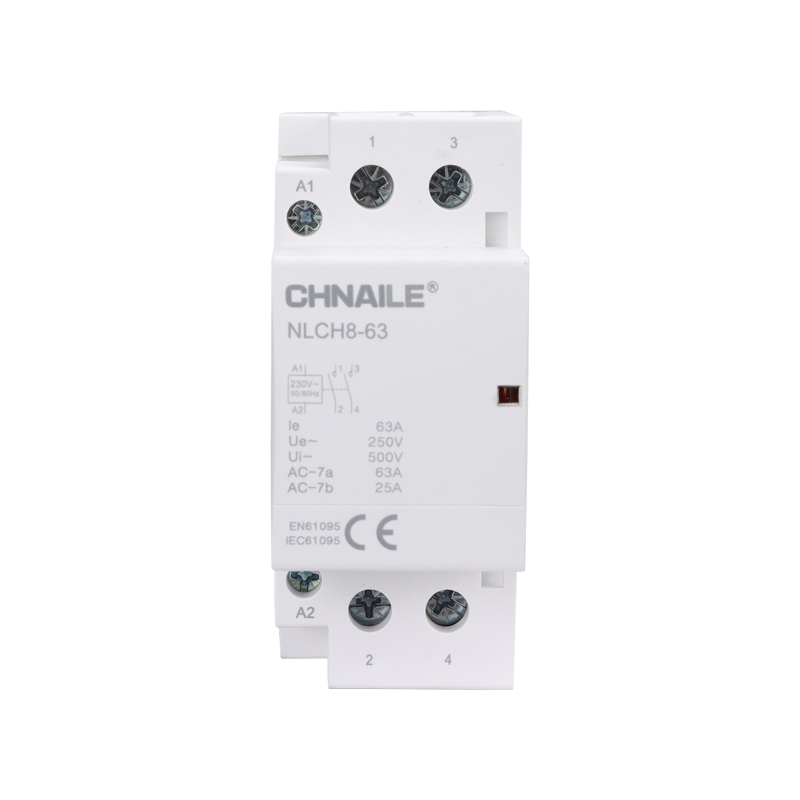
The NLCH8-63 series modular contactor, manufactured by CHNAILE, is a DIN-rail mounted switching device designed for utility switchboards, building automation systems, and industrial control panels. Available in 2-pole and 3-pole configurations, this device supports rated operational current up to 63A under resistive load conditions, and is produced via automated manufacturing lines. It serves as a compact switching solution for commercial procurement teams, system integrators, and switchgear fabricators working on infrastructure and building control projects.
Parameter | Detail |
|---|---|
Brand | CHNAILE |
Series Model | NLCH8-63 |
Pole Configurations | 2-Pole (NLCH8-63-2P), 3-Pole (NLCH8-63-3P) |
Rated Insulation Voltage (Ui-) | 500V |
Rated Operational Voltage (Ue-) | 250V, 400V |
Rated Operational Current (AC-7a) | 63A |
Rated Operational Current (AC-7b) | 25A |
Utilization Categories | AC-7a, AC-7b |
Applicable Standards | IEC61095, EN61095 |
Certification | CE |
Mounting Method | DIN-rail mounting |
| |
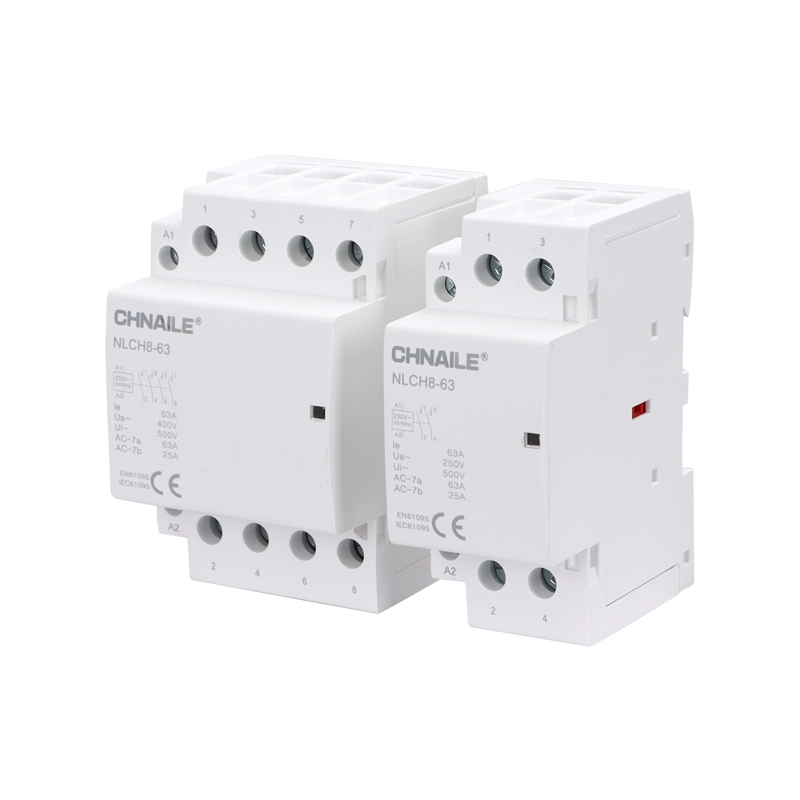
The contactor features a chassis constructed from fire-retardant polymer material, which supports heat dissipation during continuous operation. This structural design limits thermal impact on adjacent DIN-rail components inside crowded distribution boards or consumer units, supporting deployment in sealed outdoor kiosks and unventilated utility substations. The compact modular footprint allows panel builders to fit more control components within a single enclosure, supporting spatial optimization goals for switchgear design.
The contactor is equipped with silver-alloy contact pads, engineered to sustain continuous current under the AC-7a utilization category defined by IEC61095. Under AC-7a conditions, the device supports 63A continuous current, suitable for resistive loads such as commercial lighting grids and architectural heating systems.
Under the AC-7b category for inductive loads, the contactor has a rated operational current of 25A. Its internal electromagnetic actuator provides consistent closing force to reduce contact bounce during switching cycles, which mitigates arcing when connecting inductive loads such as compressor motors in municipal pumping stations. This dual-category rating allows panel designers to use a single device type across multiple load types, simplifying internal wiring schematics for control panels.
This series of modular contactors is suitable for integration into various electrical control systems. Common use cases include building automation control panels, HVAC distribution boards, municipal street lighting control matrices, and electric vehicle charging node panels. It can also be deployed in industrial control cabinets and residential distribution boards that require automated switching functions. The DIN-rail mounting design is compatible with standard low-voltage switchboard enclosures, allowing direct integration into existing panel assembly workflows.
CHNAILE offers a full range of modular contactors with current ratings spanning 6A, 16A, 25A, 40A, 50A, and 63A, all sharing the same modular design and DIN-rail mounting footprint. For commercial procurement teams working on large-scale infrastructure projects, standardizing on this unified product line allows for consistent mounting calculations and uniform visual identification across all enclosures, supporting vendor consolidation efforts.
For switchgear fabricators and system integrators, the manufacturer supports OEM branding customization for bulk orders. All products in the series carry CE certification and comply with IEC61095 and EN61095 standards, allowing private-label deployment for global projects. Requests for accessory integration and custom production runs are managed by the export engineering team to support cross-border project cooperation.
NLCH8-63 series contactors comply with IEC61095 and EN61095 standards for electromechanical contactors for household and similar purposes, and carry CE certification.
AC-7a is a utilization category for resistive and slightly inductive loads, such as lighting and heating circuits, under which this contactor supports 63A rated current. AC-7b applies to motor loads and other highly inductive circuits, under which this contactor has a 25A rated current.
Yes, the NLCH8-63 series is available in both 2-pole and 3-pole configurations, with model designations NLCH8-63-2P and NLCH8-63-3P respectively. Both configurations share the same DIN-rail mounting form factor and compliance certifications.
Yes, OEM branding customization is available for bulk orders, allowing switchboard manufacturers to apply their own branding to certified contactor units. Requests for custom packaging and marking can be coordinated with the export engineering team.