Nale Electric is willing to work together with domestic and foreign merchants to create brilliance!


| Quantity: | |
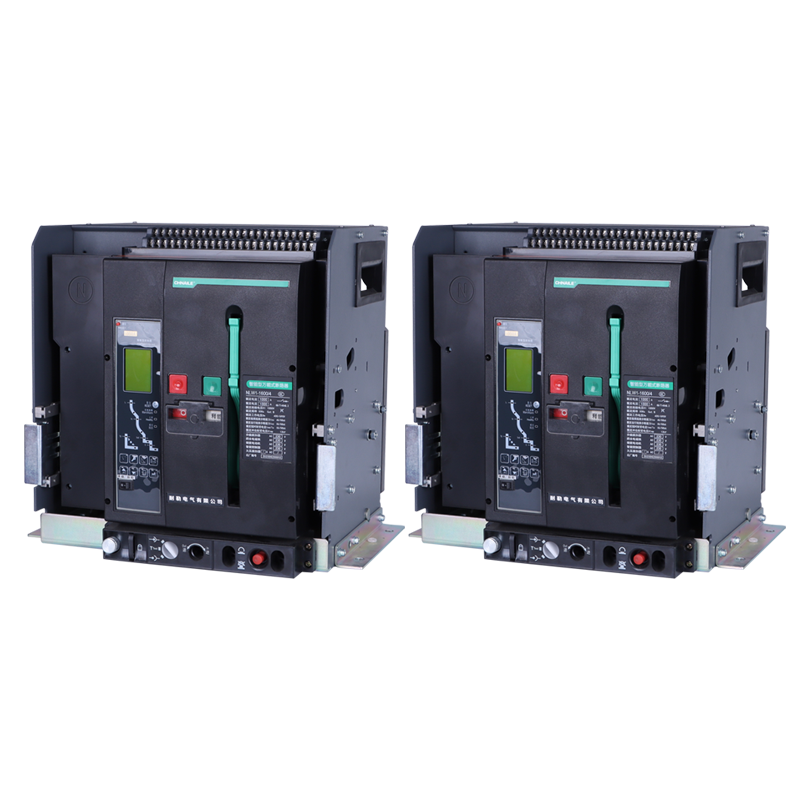
The decision to specify a draw-out (withdrawable) ACB rather than a fixed-mounted equivalent is, in the context of main distribution board design for commercial buildings, municipal substations, and data centre power infrastructure, a maintenance economics decision whose financial justification compounds with the operational lifetime of the installation. In a fixed-mounted ACB configuration, any maintenance operation that requires physical access to the breaker's contact system, arc chute, or mechanism — planned maintenance, post-fault inspection following a short-circuit trip, or contact replacement following an arc erosion event — demands de-energisation of the entire busbar section that the ACB protects, an outage event whose cost in a live commercial building or a continuously operating data centre is measured not in equipment repair hours but in revenue impact, tenant contractual penalties, and reputational consequence. The draw-out chassis architecture of the NLW1-1600/4P resolves this maintenance access problem at the design level: the breaker cassette separates from its fixed chassis cradle through the racking mechanism — actuated via the racking handle socket visible at the bottom-left of the control row in the product image — through three positions: connected (main contacts engaged, control circuits energised), test (main contacts isolated, control circuits energised for functional testing without load), and disconnected (both main and control circuits isolated, cassette fully withdrawn for bench maintenance). This three-position racking sequence allows the commissioning engineer to execute functional test cycles — verifying trip unit response, motor operating mechanism, and auxiliary contact operation — with the main contacts physically separated from the live busbars, without requiring a full busbar section outage, and allows maintenance personnel to withdraw the cassette for contact inspection and arc chute replacement while the busbar section remains energised through a parallel bus-coupler or alternative incomer, reducing planned maintenance outage windows from hours to minutes in redundant incomer configurations.
| Device Category: | Air Circuit Breaker (ACB / Universal Circuit Breaker) |
| Poles Configuration: | 4P (Simultaneous 3-Phase + Neutral Isolation) |
| Rated Current (In): | 1000A (Calibrated for massive commercial loads) |
| Rated Operating Voltage (Ue): | AC 400V / 690V |
| Rated Insulation Voltage (Ui): | 1000V |
| Rated Impulse Withstand Voltage (Uimp): | 12kV (Extreme grid surge and lightning defense) |
| Ultimate Breaking Capacity (Icu): | 65kA (High-tier open-air plasma suppression) |
| Control Core: | Intelligent Microprocessor Trip Unit (with LCD interface) |
| Installation Architecture: | Drawout / Withdrawable Type (Cradle mounted) |
| Standard Compliance: | GB/T 14048.2 / IEC 60947-2 |

The intelligent trip unit — the most visually prominent element of the device's front face, presenting a backlit LCD screen displaying the current set value of 1000 A against the 1600 A frame in the product image, with a row of function-selection push buttons below the display — is not merely a digital replacement for the conventional analogue dial adjustments of a thermal-magnetic trip unit. It is a protection coordination management instrument that eliminates several categories of commissioning error and post-fault diagnostic delay that conventional analogue trip units impose on the switchgear assembly contractor and the building commissioning engineer. The LCD display's real-time current set value presentation — showing the long-time protection current in the format visible in the image — provides a single-glance confirmation of the protection setting that the commissioning engineer can verify against the coordination study without requiring a physical inspection of rotary dial positions or the use of an external clamp meter, reducing the commissioning verification checklist time for each ACB position and producing a documented commissioning record that corresponds to what is actually set rather than what was intended to be set. The LISG four-function protection architecture — Long-time (L), Instantaneous (I), Short-time (S), and Ground-fault (G) protection, each independently adjustable through the trip unit's interface — provides the protection engineer with the complete toolkit required to achieve selective coordination across the full fault current spectrum from sustained overload through bolted three-phase short circuit to high-impedance ground fault, in a single device without supplementary relay modules or external protection relays. The Long-time function protects the downstream cable and equipment against sustained overcurrent by inverse-time tripping with a time-current characteristic that is adjustable to match the thermal capacity of the protected conductor. The Instantaneous function provides high-speed short-circuit interruption without intentional delay. The Short-time function introduces a defined time delay before tripping under short-circuit conditions, allowing downstream protective devices to clear faults within their own zone before the upstream ACB interrupts — the selective coordination mechanism that preserves supply continuity to unfaulted parts of the LV network during a downstream fault event. The Ground-fault function detects current imbalance between the phase conductors and the neutral, responding to fault currents that flow through unintended earth paths below the level that the overcurrent protection would detect, providing the equipment and fire protection function mandated by IEC 60364-4-43 for certain electrical system configurations.

The certification architecture underpinning the NLW1-1600/4P — CB Scheme certification under the IECEE framework and TUV third-party type-test report validation — represents a specific answer to the question that national utility procurement authorities, government infrastructure project consultants, and independent commissioning engineers ask when reviewing the ACB specification in a switchgear delivery: not "does this device meet IEC 60947-2?" but "can you produce independent laboratory evidence, from a globally recognised accredited body, that this specific device design was physically tested to IEC 60947-2 and achieved the rated performance across the full test schedule including short-circuit making and breaking capacity, temperature rise, dielectric withstand, and mechanical and electrical endurance?" The CB Scheme certificate answers this question with a globally portable test report — accepted by IECEE member body national certification authorities across more than fifty countries, including the certification bodies of the Gulf Cooperation Council, East Africa's regulatory framework, and the major Latin American markets — without requiring re-testing by a local laboratory for each destination market, a re-testing obligation that adds both cost and lead time to the switchgear contractor's delivery schedule. The TUV report provides an additional layer of independent validation from one of the most globally recognised inspection and certification organisations, whose name carries authority with end-client technical departments and government electrical inspectorates that may not have direct familiarity with the CB Scheme framework. Together, the CB certificate and TUV report constitute a documentation package that has been observed to accelerate government infrastructure project equipment approval processes by eliminating the "additional evidence required" phase of the inspection that undocumented or self-certified products routinely trigger. For switchgear assembly factories — the 成套厂 and panel builder operations that constitute the primary commercial channel for ACB procurement at the project level — this certification portfolio is the component of our supply that cannot be replicated by a competing source factory operating without third-party test infrastructure: a factory can offer a lower unit price, but it cannot offer a CB certificate that a national certification authority will accept without the underlying IECEE-accredited laboratory test data that only a genuine type-test programme generates. Our willingness to make the type-test report extracts available as part of the OEM supply documentation package — under the panel builder's own brand designation where private-label supply is agreed — transfers the certification capital of our test investment to the panel builder's own product specification, enabling them to respond to government tender equipment approval requirements with the same documentation confidence as a European ACB brand, at a delivered cost that preserves the margin differential that makes the source-factory supply relationship commercially rational.
The rated current configurability of the NLW1 platform — 630 A through 8000 A across the full frame series, with the 1600 A frame shown in the product image representing the mid-range of the portfolio — is the specification parameter that determines whether a switchgear assembly factory can serve its full project portfolio from a single qualified ACB supplier relationship or must maintain parallel qualification processes for multiple suppliers at different current tiers. A switchgear factory whose project portfolio spans commercial building main distribution boards (typically requiring ACBs in the 630 A to 1600 A range for transformer secondary incomer positions serving buildings with 800 kVA to 2000 kVA transformer installations), municipal substation LV switchgear (requiring ACBs in the 1600 A to 3200 A range for large transformer secondary buses), data centre main distribution units (requiring ACBs from 1600 A through 4000 A for high-density power distribution architectures), and BESS container AC bus protection (requiring ACBs from 630 A to 2500 A depending on the battery system's rated AC power output) is, if sourcing ACBs from multiple manufacturers at different current tiers, managing a qualification overhead — in engineering review time, in procurement administration, in documentation management, and in the risk of supply disruption at any individual supplier — that scales with the number of supplier relationships rather than with the volume of switchgear delivered. Consolidating this ACB procurement onto a single factory platform whose frame series covers the full current range of the switchgear factory's project portfolio reduces the qualification overhead to a single relationship, a single documentation package, and a single logistics management process — a consolidation whose financial value to a switchgear factory delivering twenty or thirty project panels per year is equivalent to the salary cost of one full-time procurement engineer, without any reduction in the specification standard or the certification documentation available to each project's commissioning engineer. The 3P and 4P pole count configurability covers both three-wire three-phase (TN-C or IT earthing) and four-wire three-phase-plus-neutral (TN-S) system architectures, and the fixed and draw-out mounting format options allow the same ACB specification to be deployed in both simplex incomer panels (where fixed mounting is economically appropriate) and duplicate incomer or incomer-plus-bus-coupler panels (where the draw-out format's maintenance access advantage justifies the premium). The manual and motorised spring-charging configurations — the motorised configuration driven by an integrated electric motor that recharges the closing spring automatically following each CLOSE operation, visible in the image through the presence of the spring-charged and closing-ready indicators in the bottom control row — determine the ACB's suitability for remote operation and automatic reclosing functions: motorised units can be integrated into building management system or SCADA-controlled automatic switching sequences without requiring local personnel to manually recharge the closing spring between operations, enabling generator auto-transfer, scheduled load management switching, and remote fault restoration sequences that manual-charge units cannot execute unattended. The optional Modbus RTU and Profibus communication modules — a factory-fit accessory that our production line installs on customer specification — extend the intelligent trip unit's parameter visibility (measured current, protective function set values, trip event log) to the building management system or the switchgear panel's SCADA gateway, enabling real-time energy metering, remote trip unit parameter adjustment, and fault event logging that transform the ACB from a protective device into a data node in the electrical infrastructure's operational intelligence network. Switchgear assembly factories, panel builder operations, data centre electrical engineers, utility procurement managers, and EPC project electrical specification teams evaluating the NLW1 ACB platform for qualification against an active or forthcoming project requirement — whether for new switchgear assembly, spares rationalisation against an installed ACB population, or development of a private-label ACB product range — are encouraged to initiate a direct technical dialogue with our manufacturing team via WhatsApp at +86 15985210820, where frame rating, pole count, mounting format, operating mechanism, protection configuration, communication protocol, and project volume parameters will be addressed by a dedicated export applications engineer returning a complete technical and commercial proposal within one working day.