Nale Electric is willing to work together with domestic and foreign merchants to create brilliance!


| Quantity: | |
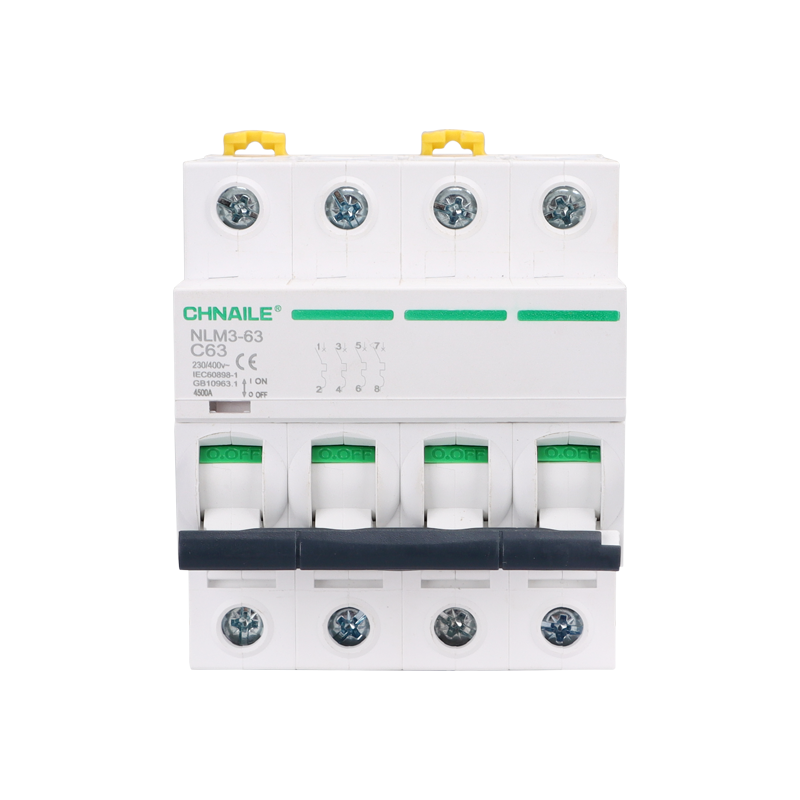
The label block of the NLM3-63 C63 4P — visible in the product image on the leftmost pole face — carries a compliance declaration whose architectural significance for the panel builder and switchgear integrator operating in project markets where both IEC and Chinese national electrical standards appear in the same project specification is immediately apparent to any procurement engineer who has navigated a mixed-standard tender submission: both IEC60898-1 and GB10963.1 are simultaneously listed as governing standards, accompanied by the CE mark that attests to Low Voltage Directive conformity. This is the only four-pole device across this entire product series to carry this dual-standard declaration, and its commercial consequence is the elimination of the device substitution problem that mixed-standard projects routinely generate when the electrical consultant specifies IEC-compliant MCBs at the sub-circuit tier while the EPC contractor's Chinese approval requirements mandate GB10963.1 CCC-marked components as a condition of government equipment acceptance. A project that specifies a single four-pole MCB specification but whose acceptance documentation requires simultaneous satisfaction of the IEC inspection authority's equipment approval (referencing IEC60898-1) and the Chinese equipment registration system's compliance record (referencing GB10963.1) cannot be served by a single-standard device — and the panel builder who has qualified the NLM3-63 for their approved component list is the panel builder who can submit a compliant tender without requesting a derogation, a substitution approval, or a supplementary documentation package that adds weeks to the project schedule.
The practical scope of this mixed-standard requirement is broader than it might initially appear, because the overlap between Chinese-invested overseas infrastructure and IEC-standard local electrical codes extends across a significantly wider geography than is commonly recognised in the procurement literature. Commercial developments in Southeast Asia — office towers in Jakarta, retail complexes in Kuala Lumpur, logistics facilities in Hanoi — that are majority-financed by Chinese capital but constructed in jurisdictions whose national electrical code references IEC60898-1 for MCB specifications will routinely generate project specifications that name IEC60898-1 for the component performance requirement while the EPC contractor's internal procurement system requires GB10963.1 certification for equipment registration in the Chinese financing institution's documentation archive. Municipal infrastructure projects in East Africa, sub-Saharan West Africa, and parts of Central Asia present the same structural duality through a different financing mechanism: projects funded under Chinese bilateral credit lines or multilateral development bank programmes that require both the borrower country's IEC-derived electrical code compliance and the Chinese lending institution's equipment specification compliance generate the mixed-standard condition in which the NLM3-63's dual certification is the procurement-level answer that single-standard devices cannot provide.
Item | Parameter |
|---|---|
Pole Number | 4 Pole |
Rated Current | 63A |
Tripping Type | C Curve |
Applicable System | Three Phase Power System |
Applicable Voltage | Industrial Common AC Voltage |
Usage Scene | Industrial Distribution, Workshop Power, Engineering Wiring |
Main Function | Overload Protection, Short Circuit Protection |
Installation Way | Standard Rail Mounted |
Adapted Equipment | Industrial Control Cabinet, Power Distribution Box |
The 4500 A breaking capacity — marked on the NLM3-63's label and lower than the 6000 A of the BD1-63S and HHM17N-63 families reviewed elsewhere in this series — is a specification distinction whose engineering significance is often misunderstood as a straightforward performance reduction. In reality, the 4500 A (4.5 kA) rating addresses a specific and legitimate protection coordination position: circuits fed from sub-distribution boards whose upstream MCCB and cable impedance have attenuated the available fault current to below 4.5 kA at the final-circuit protective device terminals. This condition is met in the overwhelming majority of commercial building tenant distribution boards, residential apartment sub-boards, and light commercial branch circuit panels fed through cable runs exceeding 20–30 metres from a standard commercial building sub-distribution board — the exact position at which a dual-standard IEC + GB certified four-pole MCB finds its highest deployment frequency in the mixed-standard project environments described above. For these positions, specifying a 6 kA device provides no additional protection value (because the available fault current does not reach 6 kA at the point of installation) while adding unit cost that the project budget does not require, whereas the 4.5 kA NLM3-63 correctly matches the breaking capacity specification to the actual fault current environment and delivers the dual-standard certification that the project's documentation requirements demand.
The NLM3-63 4P's contact operation architecture — observable in the product image as a combination of four individual white toggle handles (each displaying "O·OFF" text and occupying its own pole channel) plus a dark grey spanning actuator bar at the lower handle zone that mechanically connects all four handles — represents a hybrid operating mechanism design whose commercial value for the panel builder is the delivery of two mutually exclusive operational requirements within a single device. The first requirement is per-pole thermal-magnetic trip independence: each pole's bimetallic strip and electromagnetic release operates independently of the others, so that a single-phase overload on one conductor trips only that pole's contact mechanism without disturbing the others — a protection behaviour that is required for correct performance of the thermal-magnetic overload function, which must be proportional to the current in the specific conductor rather than influenced by the current in adjacent conductors. The second requirement is single-gesture simultaneous manual switching: when the operator manually actuates the device — pushing the handle from ON to OFF for isolation, or from OFF to ON for energisation — all four poles must move simultaneously to prevent the transient single-phase or two-phase conditions that sequential pole actuation produces in a live three-phase-plus-neutral circuit. These two requirements are architecturally in tension: per-pole trip independence demands mechanical decoupling between poles, while simultaneous manual switching demands mechanical coupling. The NLM3-63's solution — individual handles that travel within their own pole channels (allowing independent trip displacement of individual handles during a thermal-magnetic trip event) combined with a unified actuator bar that transmits manual switching force across all four handles simultaneously (enforcing simultaneous pole operation during deliberate manual actuation) — satisfies both requirements without the compromise that either a purely independent handle design (which cannot ensure simultaneous manual switching) or a purely unified handle design (which may resist individual pole thermal-magnetic trip displacement) would impose. The dark grey colour of the unified actuator bar — contrasting with both the white housing and the white individual handles — provides the immediate visual identification of the actuator element that the maintenance technician uses when approaching the panel for a manual switching operation, allowing the correct contact point for switching force application to be located without close-approach panel label reading.
The yellow cable-guide accessories visible at the two leftmost line-side terminal entries in the product image — bright amber-yellow insulating elements inserted into the terminal cavity entry openings — are the NLM3-63's most visually distinctive detail and the component that most unambiguously differentiates this device from every other four-pole MCB reviewed in this series. These accessories serve a conductor entry guidance function that is particularly valuable during the panel assembly wiring sequence at the four-pole device tier: at 63 A three-phase, the minimum cable cross-section for the line-side conductors is typically 16–25 mm² (depending on installation method, grouping factor, and ambient temperature), and the mechanical stiffness of conductors in this cross-section range makes guided insertion into the terminal cavity a measurable improvement over unguided insertion at the panel assembly speed that commercial board production requires. The yellow guides' function is to present the stripped conductor end to the terminal screw contact zone without requiring the assembly technician to manually direct the conductor tip into the terminal aperture — a hand-alignment step that, at 25 mm² conductor stiffness, requires repositioning the conductor repeatedly before the stripped end engages the terminal correctly. The four green horizontal identification stripes across all four module tops — visible as bold green bars spanning the complete four-module width of the device — complete the visual identification grammar with a panel population reference that allows a panel assembler to distinguish the four-pole NLM3-63 from all adjacent devices by stripe count: the four stripes confirm four modules at the panel population audit glance, without module-by-module physical measurement or label reading. Together with the white handles, dark actuator bar, and yellow cable guides, the four green stripes form a visual identity unique to the NLM3-63 4P within this product family — a combination of colour and structural detail whose specificity provides Google with unambiguous evidence that this content addresses a specific device rather than a generic product category description.
The procurement rationalisation argument for the NLM3-63 4P platform is most precisely expressed through the lens of the mixed-standard project portfolio management problem that confronts a panel builder or switchgear integrator whose annual production schedule includes both IEC-standard commercial projects (for Gulf, African, or Southeast Asian clients whose local electrical code references IEC) and GB-standard projects (for Chinese EPC contractors or Chinese-invested developments whose equipment specifications reference GB national standards). Without a dual-certified four-pole MCB, this mixed-standard portfolio requires the panel builder to maintain two separate approved component list entries for the four-pole MCB category — one IEC-certified device for IEC-standard projects and one GB/CCC-certified device for GB-standard projects — each requiring its own type-test certificate management, its own factory audit record, and its own delivery logistics relationship. The NLM3-63's dual IEC60898-1 + GB10963.1 certification collapses this two-entry overhead into a single qualified component whose documentation package satisfies both inspection authority requirements, reducing the four-pole MCB category's compliance management cost to a single annual re-evaluation rather than two, and eliminating the inventory carrying cost of maintaining separate stock positions for IEC and GB variants at the same current rating. The rated current configurability from 6 A to 63 A within the NLM3-63 4P frame extends this rationalisation across the full four-pole sub-circuit current range that a commercial distribution board design requires — from the 6 A four-pole circuit position protecting a small three-phase instrumentation circuit through the 16 A and 20 A positions serving three-phase small power and lighting circuits, the 32 A and 40 A positions covering HVAC equipment and motor branch circuits, to the 63 A sub-incomer position reviewed here. The housing colour — standard white as shown, but configurable to custom specification at OEM order stage — and the private-label face marking — replacing the NLM3-63 designation with the panel builder's own brand and model series — allow the dual-certified platform to be deployed as a branded component in both the IEC-market and GB-market segments of the panel builder's project portfolio, under a single brand identity that the end-client's electrical consultant and the project inspection authority recognise as the panel builder's own product rather than a third-party component whose certification status must be independently verified. Panel builders, switchgear integrators, commercial building EPC electrical contractors, and mixed-standard project procurement managers evaluating the NLM3-63 4P platform for four-pole three-phase-plus-neutral circuit protection across IEC and GB-standard project environments are encouraged to initiate a direct technical dialogue with our manufacturing team via WhatsApp at +86 15985210820, where rated current, dual-standard certification documentation, housing colour, actuator bar specification, and project volume parameters will be addressed by a bilingual export applications engineer returning a complete technical and commercial proposal within one working business day.