Nale Electric is willing to work together with domestic and foreign merchants to create brilliance!


| Quantity: | |
Diagnosing Ground Fault Vulnerabilities in Municipal Distribution Architectures
A pervasive structural flaw frequently identified during the rigorous commissioning phases of national grid infrastructure and large-scale commercial solar projects involves the misapplication of residual current protection at the main incomer level. Procurement teams at switchgear assembly plants often specify fixed-sensitivity earth leakage breakers for Main Distribution Boards (MDBs) attempting to manage heavy continuous loads, such as the 250-Ampere threshold. This fragmented engineering approach inevitably invites catastrophic operational instability. In sprawling commercial facilities, the sheer volume of underground cabling and the presence of numerous variable frequency drives generate inherent, harmless background capacitive leakage. A rigid, non-adjustable main breaker interprets this accumulated baseline noise as a critical fault, triggering a frustrating sequence of nuisance trips that paralyze the entire commercial operation. The financial penalties associated with dispatching emergency utility maintenance crews to reset a miscalibrated main breaker frequently destroy the profit margins of the original panel builder.
Technical Parameters
| Device Category: | Adjustable Earth Leakage Molded Case Circuit Breaker (Industrial RCBO) |
| Poles Configuration: | 4P (Type B Logic: Simultaneous 3-Phase + Neutral Disconnect) |
| Rated Current (In): | 250A (Sustains massive continuous commercial loads) |
| Rated Operating Voltage (Ue): | AC 400V (50Hz) |
| Rated Insulation Voltage (Ui): | 1000V (Exceptional dielectric strength) |
| Rated Impulse Withstand Voltage (Uimp): | 12kV (Utility-grade atmospheric surge defense) |
| Ultimate Breaking Capacity (Icu): | 35kA (L-Type robust fault suppression) |
| Adjustable Leakage Current (IΔn): | 100mA / 300mA / 500mA (Blue Rotary Dial) |
| Adjustable Time Delay (Δt): | 0.1s / 0.4s / 1.0s (Blue Rotary Dial) |
| Instantaneous Magnetic Trip (Ii): | 10In (2500A - Immune to heavy motor inrush) |
| Standard Compliance: | GB/T 14048.2 / IEC 60947-2 |

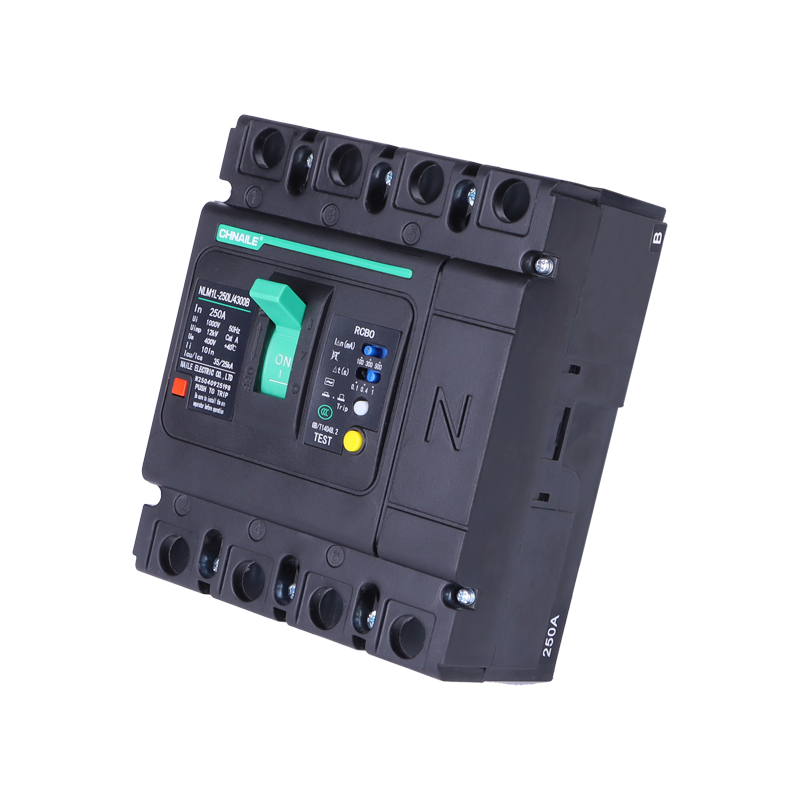
Addressing this critical failure point necessitates a transition toward sophisticated, programmable fault coordination, a mechanism meticulously integrated into the CHNAILE NLM1L-250L platform. An analytical review of the device's front control fascia uncovers a distinct blue dial matrix governing the residual current parameters. This specific interface empowers site commissioning engineers to establish absolute "Earth Fault Selectivity." By deliberately increasing the leakage tolerance threshold (IΔn) to 300mA or 500mA, the main breaker ignores harmless infrastructural capacitive noise. Crucially, the secondary temporal dial (Δt) allows technicians to introduce an intentional mechanical delay of 0.1, 0.4, or 1.0 seconds. Should a genuine, dangerous ground fault occur on a 32-Ampere sub-circuit, this 250A main incomer detects the anomaly but intentionally waits, forcing the localized downstream miniature circuit breaker to trip and isolate the hazard first. This cascaded protection strategy ensures that the primary 250-Ampere municipal feed remains uninterrupted, drastically elevating the reliability metrics of the distribution panels you fabricate and guaranteeing seamless approval from government electrical inspectors.

The Necessity of Total Galvanic Isolation and Automated Manufacturing Precision
Compounding the complexity of ground fault management is the physical topology of the electrical network itself. As indicated by the "4300B" structural nomenclature on the chassis, this specific unit is engineered with a comprehensive 4-Pole architecture. In modern environments integrating backup diesel generators or decentralized solar battery storage, the neutral conductor must be treated with extreme caution. If a main 250A switch interrupts only the three active phases during a maintenance cycle, lethal reverse-fed harmonic currents can travel backward through the unbroken neutral line, presenting a fatal electrocution hazard to utility personnel servicing the enclosure. The synchronized mechanical carriage within this heavy-duty MCCB guarantees that the massive neutral contacts are severed simultaneously with the phase lines, establishing an impenetrable galvanic void. Supported by an 800V dielectric insulation barrier (Ui) and an impressive 50,000-Ampere (50kA) short-circuit plasma quenching capacity, the physical resilience of this unit provides an unyielding defense against severe grid transients.

Target Application Scenarios
Because of its customizable leakage coordination, Type B 4-pole isolation, and massive 250A capacity, this MCCB is strictly mandated by international EPCs for:
Commercial Solar AC Combiners: Serving as the foolproof main AC disconnect switch between high-capacity central inverters and the utility grid, immune to capacitive leakage.
Mining & Slurry Processing: Providing highly regulated, nuisance-free earth fault protection for heavy-duty, deep-shaft dewatering pumps in vibrating subterranean environments.
Large-Scale Agricultural Irrigation: Acting as the primary power gateway for multi-hectare sprinkler systems where extremely long cable runs generate high background leakage.
Heavy Port Infrastructure: Ensuring multi-tiered leakage safety and continuous power for massive dockside refrigerated container (Reefer) terminal boards.
However, the theoretical brilliance of an adjustable, 4-Pole protective device is rendered completely invalid if the physical manufacturing process lacks absolute consistency. When a switchgear fabrication firm requests deep customization—such as altering the exterior polymer housing to a proprietary brand color, designing custom packaging to streamline their internal logistics, or requesting specific non-standard amperage calibrations across 1P, 2P, 3P, or 4P configurations—relying on antiquated manual assembly introduces severe quality control risks. The CHNAILE operational model strictly mitigates these risks by executing all bespoke manufacturing runs exclusively on state-of-the-art smart automated assembly lines. The delicate tensioning of the bimetallic overload strips and the precise calibration of the zero-sequence current transformers responsible for leakage detection are handled by sub-millimeter robotics. Following automated assembly, absolute fidelity is validated as every single customized unit navigates our computerized smart inspection equipment. These digital testing matrices subject the breakers to simulated multi-kA fault currents, recording exact tripping latencies to verify strict compliance with IEC 60947-2 standards prior to international export. We strongly encourage procurement executives, chief electrical designers, and switchboard fabricators seeking to eradicate assembly line vulnerabilities and establish a highly customized, reliable procurement pipeline to initiate a detailed technical dialogue with our manufacturing liaisons via WhatsApp at +86 15985210820. Align your enclosure fabrication processes with a genuine smart-manufacturing powerhouse to secure your dominance in the global electrical infrastructure market.


