Nale Electric is willing to work together with domestic and foreign merchants to create brilliance!


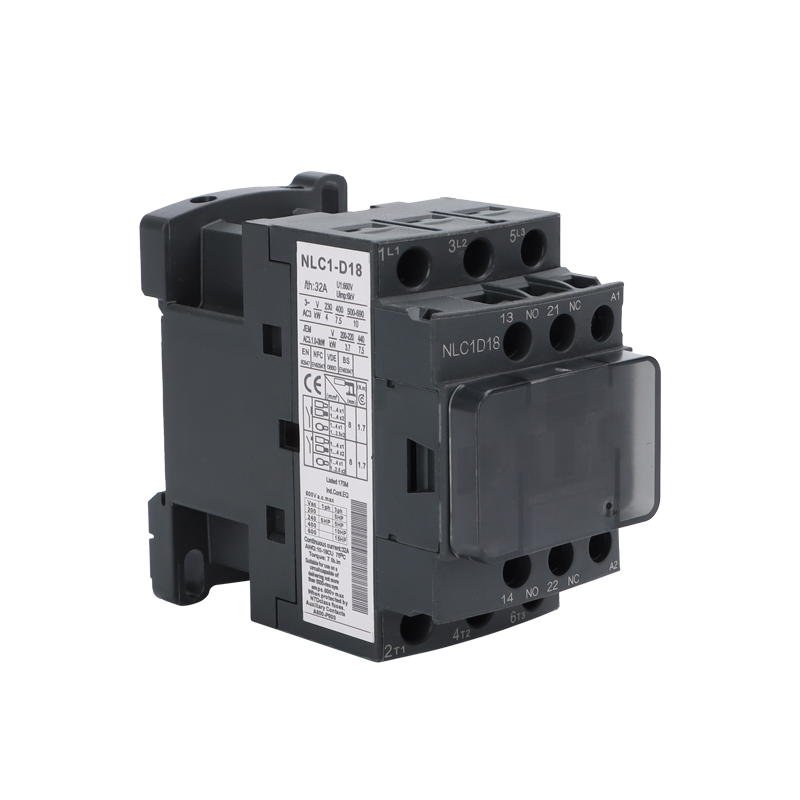
The NLC1D18 is a 3-pole IEC magnetic contactor designed for motor control and power switching applications in commercial and industrial electrical systems. Manufactured by CHNAILE on automated production lines, this 18A contactor complies with IEC 60947-4-1 and EN 60947-4-1 standards, with VDE certification markings on each unit. The device supports AC-3 utilization category at 400V, making it suitable for controlling squirrel-cage motors up to 7.5 kW. Integrated auxiliary contacts and a dust-resistant housing design distinguish this model for use in switchgear panels, motor control centers, and distribution boards.
Parameter | Value |
|---|---|
Model | NLC1D18 |
Number of poles | 3 |
Rated operational current (Ie) AC-3 at 400V | 18 A |
Conventional thermal current (Ith) | 32 A |
Rated operational power (AC-3 at 400V) | 7.5 kW |
Auxiliary contacts | 1 NO + 1 NC (integrated) |
Auxiliary contact terminal markings | 13-14 (NO), 21-22 (NC) |
Coil voltage options | 24V, 110V, 220V, 380V AC |
Standard compliance | IEC 60947-4-1, EN 60947-4-1 |
Certification marks | CE, VDE |
Mounting type | DIN rail or screw mounting |
Electrical endurance (AC-3) | 1,000,000 operations |
Mechanical endurance | 10,000,000 operations |
A key feature of the NLC1D18 contactor is its integrated auxiliary contact system, molded directly into the main housing. Unlike contactors that require separately purchased and mounted auxiliary contact blocks, this design provides one normally open (13-14) and one normally closed (21-22) auxiliary contact as standard. This configuration eliminates the need for add-on modules, reducing the component count on the Bill of Materials and saving DIN rail space inside control panels.
Panel assembly technicians can wire interlocking circuits, status indication loops, and PLC feedback signals directly from the integrated terminals. The auxiliary contacts are rated for 10A conventional thermal current, supporting control circuit voltages up to 690V. This integrated approach reduces assembly time per panel and minimizes the number of connection points, which contributes to consistent wiring quality across production batches.
The NLC1D18 incorporates a transparent dust shield over the magnetic core assembly, providing protection against airborne particulate matter commonly found in manufacturing facilities, construction sites, and solar inverter installations. Conductive dust and metallic shavings that settle on the armature surface can cause contact chattering, increased coil temperature, and premature failure. The dust shield deflects these particles away from the magnetic mechanism, helping to maintain consistent operation in dusty environments.
Internally, the main contacts are sized to handle 32A of conventional thermal current (Ith), providing thermal capacity above the 18A AC-3 rated operational current. This margin supports the inductive inrush currents associated with motor starting. The contact material is formulated for AC switching duty, with arc chutes designed to extinguish arcs within the contact gap during switching operations.
The NLC1D18 3-pole contactor serves across multiple electrical assembly applications. In national grid control panels and Main Distribution Boards (MDBs), it handles auxiliary circuit switching and control logic operations. For solar inverter systems, the contactor manages AC side switching and synchronization circuits. In HVAC installations, it controls fan motors and compressor circuits. Municipal water pumping stations and factory conveyor systems also deploy this model for motor starting and duty cycling.
The compact form factor allows for denser panel layouts, which is relevant when designing enclosures with limited internal space. Standardized dimensions across the NLC1 series enable panel designers to create modular layouts that accommodate different current ratings within the same footprint template.
CHNAILE manufactures the NLC1 contactor platform across a current range from 6A to 63A, all sharing the same architectural design and mounting dimensions. This scalability allows switchgear OEMs and panel builders to standardize on a single contactor family across their product lines, reducing engineering documentation overhead and simplifying spare parts inventory.
Customization options include specific coil voltages to match regional grid standards, custom terminal configurations, and white-label branding for volume orders. Production runs are scheduled through direct coordination between the customer engineering team and CHNAILE manufacturing planning, with lead times aligned to project delivery schedules.
Ie (rated operational current) is the current the contactor can switch under specific utilization category conditions, such as 18A for AC-3 at 400V. Ith (conventional thermal current) is the maximum current the main circuit can carry continuously without exceeding temperature rise limits, which is 32A for the NLC1D18.
Yes. While the contactor has 3 poles, it can be wired for single-phase applications by using two poles in series or by paralleling poles for higher current capacity. Consult the application guidelines for specific derating factors.
Standard coil voltages include 24V AC, 110V AC, 220V AC, and 380V AC 50/60Hz. Custom coil voltages can be produced for volume orders to match specific national grid standards.
The NLC1D18 is designed for AC switching applications. For DC load switching, refer to the NLC1-DC series contactors specifically rated for DC utilization categories.
CHNAILE provides a 24-month warranty from the date of delivery, covering manufacturing defects under normal operating conditions within the published technical specifications.