Nale Electric is willing to work together with domestic and foreign merchants to create brilliance!


| Quantity: | |
Rethinking Changeover Mechanics in Single-Phase Distribution Panels
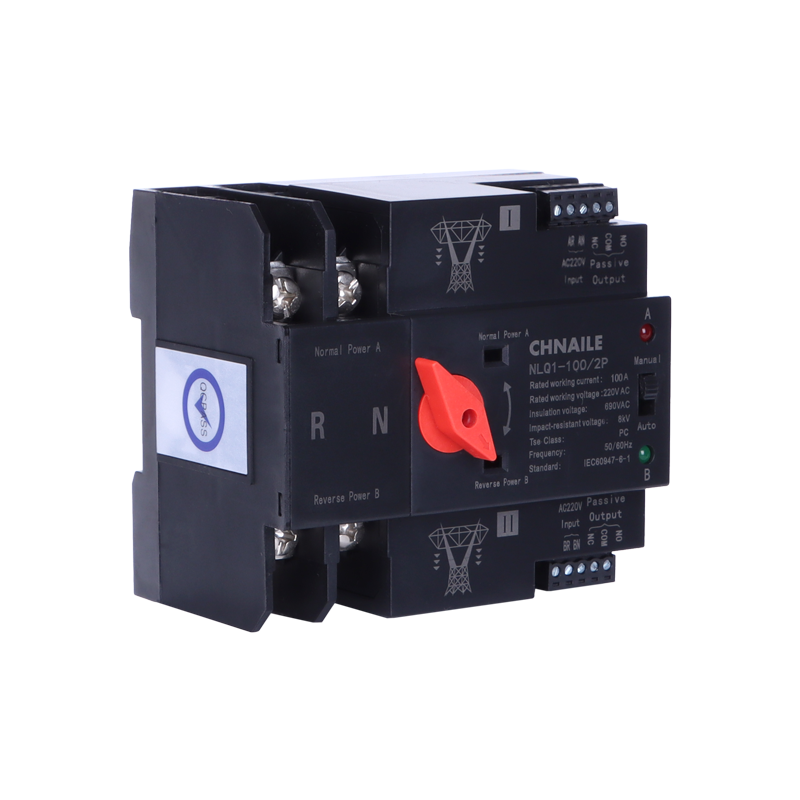
The logistical realities of assembling commercial and high-end residential backup power cabinets demand an intense focus on component efficiency and wiring simplicity. When panel builders are tasked with engineering a distribution board that integrates municipal utility power with an external diesel generator or a heavy-duty solar battery inverter, the choice of the transfer switch fundamentally dictates the reliability of the entire system. Standard circuit-breaker-based (CB-Class) transfer switches often introduce unnecessary complications; their internal thermal bimetals are susceptible to the massive, temporary voltage fluctuations and inrush currents typically generated when a large standby generator first spools up, occasionally resulting in frustrating nuisance trips that leave the facility in the dark. To circumvent this widespread assembly issue, the CHNAILE engineering division developed the NLQ1-100 platform as a strictly PC-Class apparatus. As visibly indicated on the component’s technical fascia, this 2-Pole 100-Ampere device relies entirely on robust, mechanically interlocking contactors. By stripping away sensitive overcurrent trip units and leaving short-circuit protection to dedicated upstream breakers, this switch guarantees that the physical transfer between the primary grid (Normal Power A) and the backup source (Reverse Power B) is executed forcefully and reliably, accommodating continuous single-phase loads of up to 22 kilowatts without accidental interruption.
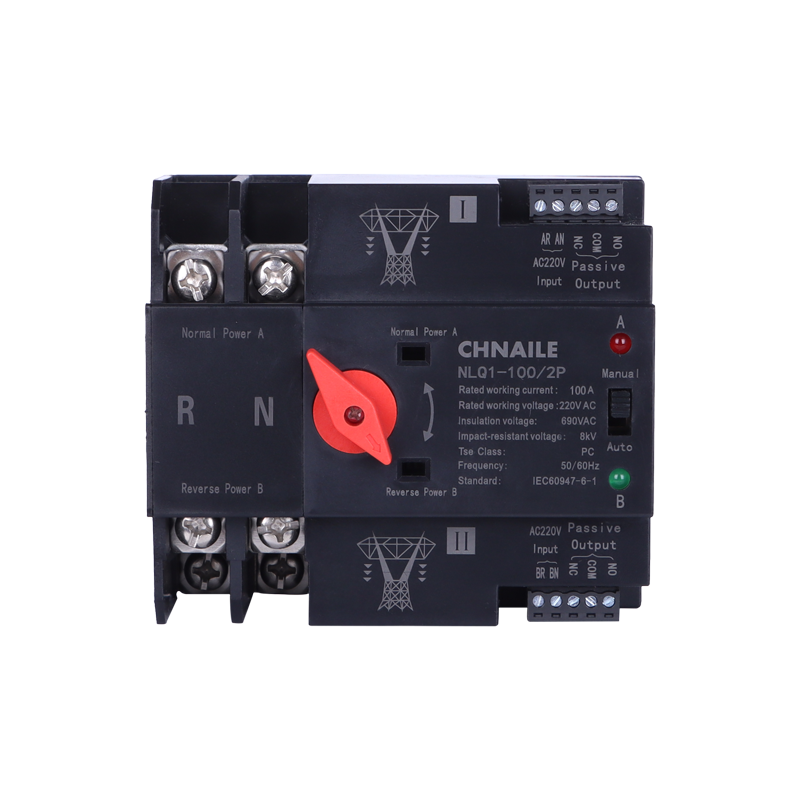
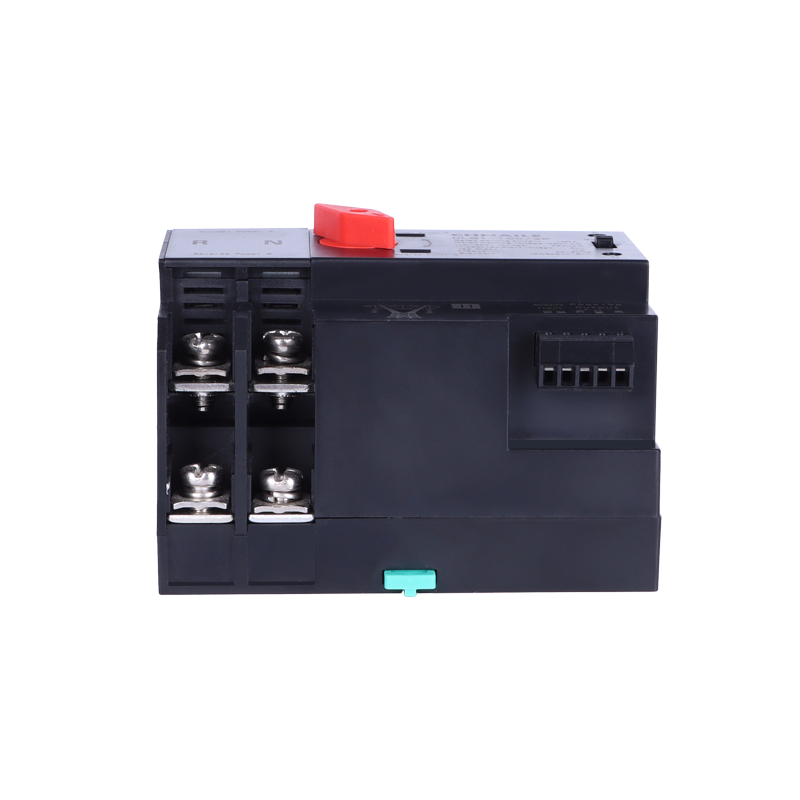
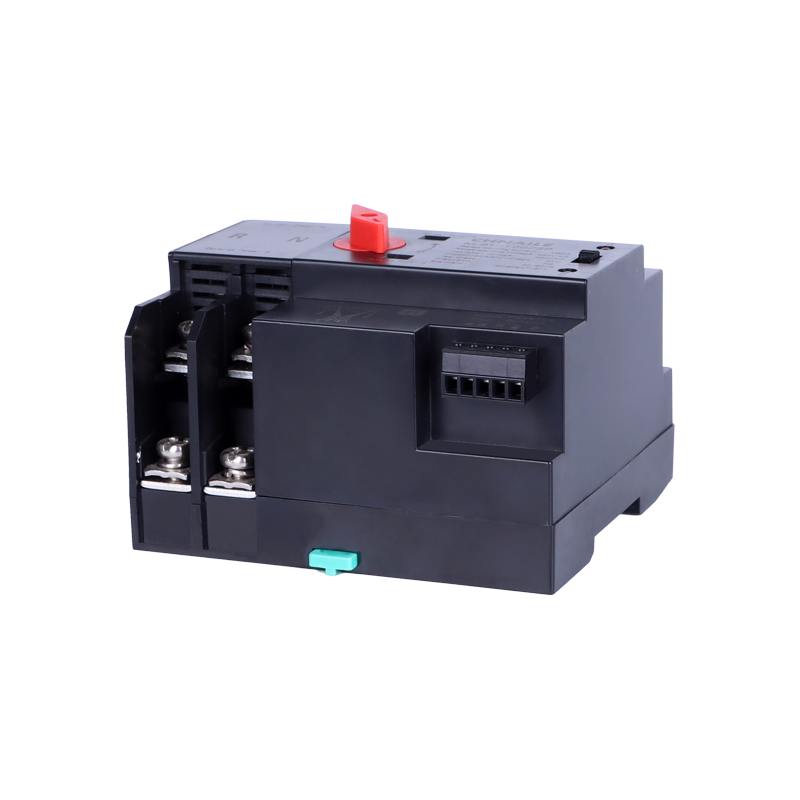
A closer visual inspection of this specific transfer switch reveals a profound structural advantage designed explicitly for the factory floor technician. Positioned at the upper right corner of the chassis is a dedicated wiring block labeled 'Passive Output' alongside 'AC220V Input'. This is a strategic integration that significantly alters the panel building workflow. In traditional generator changeover cabinets, assemblers must purchase and manually wire separate intermediate relays and voltage-sensing modules to send a start command to the diesel generator when the municipal grid fails. The CHNAILE ATS internalizes this logic. The integrated dry contacts (passive output) act as an immediate signaling pathway, automatically closing to trigger the generator's ignition cycle the moment a primary voltage drop is detected. For a switchgear manufacturing enterprise producing hundreds of backup panels annually, eliminating the need to source, mount, and wire external signaling relays translates into a dramatic reduction in Bill of Materials (BOM) costs and a substantial decrease in labor hours per cabinet, directly amplifying the profitability of your commercial contracts.
Ensuring Defect-Free Operations Through Smart Manufacturing
However, integrating advanced signaling and heavy-duty 100A mechanical switching into a compact footprint requires manufacturing tolerances that manual labor simply cannot consistently achieve. Supplying national grid projects and critical solar infrastructure mandates absolute batch uniformity. CHNAILE refuses to compromise on electro-mechanical integrity. The entire internal architecture of this ATS—from the high-tension arc suppression chambers designed to manage the 8kV rated impulse withstand voltage (Uimp), to the motorized actuation carriage—is assembled utilizing our proprietary smart automated production lines. This robotic fabrication ensures that every terminal screw, contact spring, and internal wire harness is torqued and positioned with sub-millimeter accuracy.
Furthermore, assembly is merely the precursor to validation. Before any transfer switch is sealed and cleared for international export, it passes through our computerized smart inspection equipment. These automated testing rigs execute thousands of simulated power-loss scenarios, verifying the precise millisecond response of the motorized drive, validating the integrity of the passive output signaling, and ensuring absolute adherence to IEC 60947-6-1 standards. This rigorous, data-driven quality assurance protocol guarantees that when your electrical contractors install a CHNAILE switch into a municipal or commercial enclosure, it performs flawlessly from day one, effectively eliminating costly post-installation warranty dispatches.
Supply Chain Elasticity and Bespoke Panel Integrations
The ultimate value proposition of partnering with a primary manufacturing source is the ability to mold the supply chain to your specific architectural requirements. Relying on trading intermediaries often forces panel builders to adapt their steel enclosures to whatever generic components are available. Our operational model reverses this dynamic. While the 100A 2-Pole model illustrated provides a highly efficient solution for standard single-phase applications, our smart manufacturing infrastructure is infinitely scalable. We possess the immediate capability to custom-engineer this exact PC-Class architecture across a full spectrum of requirements. Whether your upcoming solar microgrid project requires a comprehensive 4-Pole configuration to ensure absolute neutral wire isolation and prevent inverter feedback, or your municipal tenders demand customized amperage ratings spanning beyond the standard 100A, we are equipped to deliver.
We actively invite procurement directors, switchboard design engineers, and global EPC contractors to bypass traditional distribution hurdles and engage directly with our manufacturing hub. We provide comprehensive OEM white-labeling services, enabling you to laser-engrave your corporate branding onto the faceplates and establish a cohesive, premium identity for your electrical panels. To discuss your specific schematic requirements, explore customized active/passive contact configurations, or to secure stabilized, factory-direct pricing for your next major infrastructure bid, our senior international engineering team is readily available for direct technical consultation via WhatsApp at +86 15985210820. Partner with CHNAILE to streamline your manufacturing process and build with absolute confidence.


