Nale Electric is willing to work together with domestic and foreign merchants to create brilliance!


| Quantity: | |
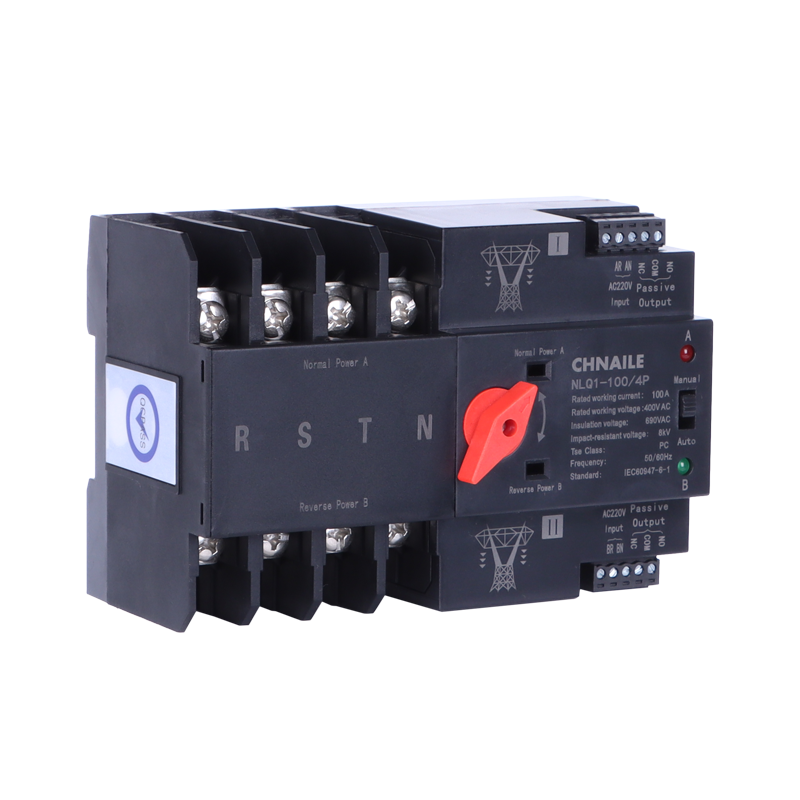
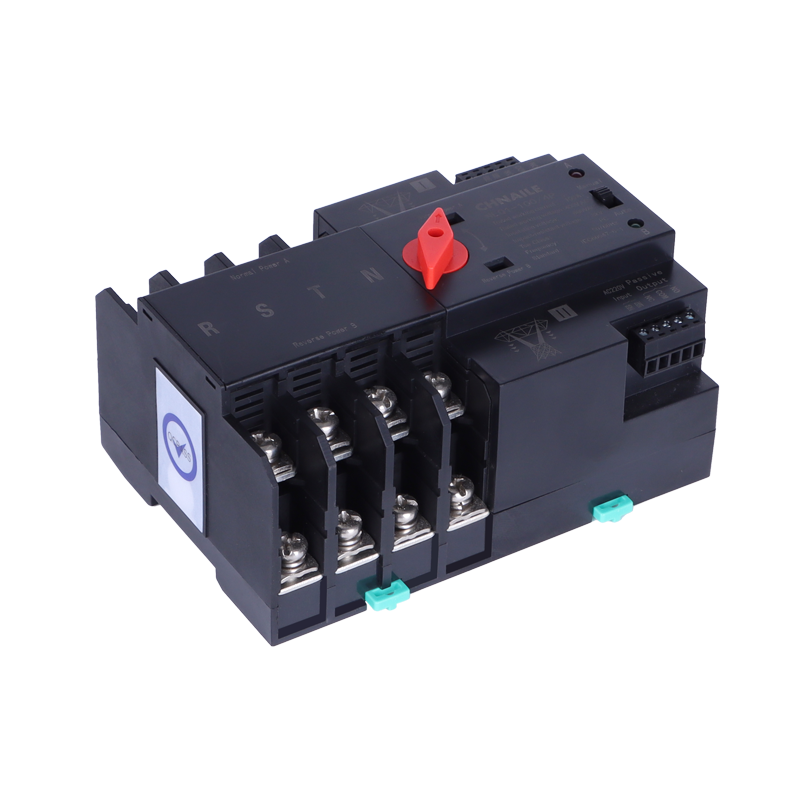
The front face of the NLQ1-100/4P communicates its engineering intent with a directness that distinguishes it from the miniature-format transfer switches occupying the single-phase residential market: this is unambiguously a three-phase bus transfer device, and every observable physical detail substantiates that classification. The four terminal banks — two at the top face (Normal Power A, line side) and two at the bottom face (Reverse Power B / Load, line side), each carrying four heavy-duty screw-clamp terminals arranged in the R-S-T-N sequence embossed in white on the black housing — establish the four-pole current path that simultaneously transfers all three phase conductors and the neutral conductor between the two sources, the architecture mandated by IEC 60364-4-46 for supply changeover in TN-S systems where a broken neutral on either the incoming or outgoing source would otherwise impose full phase-to-phase voltage across single-phase loads connected line-to-neutral. The matte-black glass-fibre-reinforced housing is not a cosmetic differentiation from the white and grey housings of DIN rail MCBs — it is a material and colour specification chosen for its compatibility with the mid-voltage switchgear cabinet environment where this ATS is most commonly deployed: the dark housing absorbs rather than reflects the heat generated by the 100 A continuous load current, reduces the visual impact of surface contamination in dusty plant rooms, and provides a contrast background against which the white-embossed terminal designations and the red rotary actuator achieve maximum legibility under the low-lux conditions typical of generator room and electrical plant room lighting. The red rotary manual actuator positioned centrally on the front face — its circular form and high-visibility colour differentiating it unmistakably from the toggle handles of MCBs and the rocker handles of smaller ATS devices in the same panel — encodes the transfer switch's fundamental operating logic in its rotation geometry: turning the actuator from position I (Normal Power A) through the neutral position (both sources disconnected, the "off" dwell that prevents simultaneous connection of two live sources) to position II (Reverse Power B) executes the manual transfer sequence in a single rotational gesture that is mechanically positive, visually confirmable from panel door distance, and immune to the accidental partial-actuation failure mode that plagues toggle-type manual operators on high-current devices. The neutral dwell between positions I and II is a mechanical interlock feature of fundamental safety significance: it enforces a break-before-make transfer sequence that prevents any momentary parallel connection of the two source supplies — a connection event that, in a generator-to-mains transfer scenario, would impose the full voltage difference between the unsynchronised generator output and the mains supply across the generator's stator windings, potentially producing overcurrent sufficient to damage the generator exciter and the ATS contact system simultaneously.
 The right-side control module — a self-contained sub-assembly visible in the product image as a raised rectangular panel occupying the right quarter of the device face — integrates the entire automatic transfer control intelligence within the ATS housing, eliminating the requirement for an external control relay, voltage-sensing module, or timer relay that earlier-generation transfer switch designs required as supplementary components. The AC 220V passive control input terminal block at the top of the right module, labelled with AR, AN, NC, COM, and NO designations visible in the image, provides volt-free relay output contacts (NO and NC) that can be wired to the generator's start circuit, the building management system's generator status input, or the BESS inverter's grid-coupling relay input — making the NLQ1-100/4P a self-contained automatic transfer control node rather than a dumb switching element requiring an external controller. The Manual/Auto selector immediately below the control terminal block allows the operator to override the automatic transfer logic for maintenance, commissioning, and emergency manual operation, with the Auto position enabling the internal voltage-sensing relay to monitor both source voltages continuously and initiate transfer automatically when the monitored source falls outside the preset voltage threshold band. The dual LED indicators — red for Source A (Normal Power) energised, green for Source B (Reverse Power) / Auto mode active — provide the real-time status display that commissioning engineers and building facilities managers require when confirming transfer switch state before or after a switching event, and their colour coding follows the international convention of red for abnormal/attention-required status and green for normal/automatic-mode-active status, minimising the risk of misinterpretation by maintenance personnel who have not been specifically trained on this device. The pylon-and-lightning-bolt graphic icons flanking the rotary actuator — one above labelled "Normal Power A" and one below labelled "Reverse Power B" — communicate the source identity in a visual language that transcends language barriers, allowing the device's transfer state to be read correctly by technicians regardless of their native language, a practical advantage in the multilingual workforce environments of large commercial construction sites across the Gulf, East Africa, and Latin America.
Parameter | Value |
| Model | NLQ1-100-4P |
| Rated Current | 100A |
| Number of Poles | 4P |
| Operating Frequency | 50/60Hz |
| Rated Operating Voltage | AC 400V |
| Insulation Voltage | 690V |
| Impulse Withstand Voltage | 8kV |
| Standard | IEC60947-6-1 |
| Operating Mode | Auto / Manual |

Securing Supply Chain Elasticity and Brand Sovereignty
While the robust 8kV impulse withstand voltage (Uimp) and the highly visible red manual override toggle provide a solid electro-mechanical baseline for safe facility maintenance, the true strategic leverage that CHNAILE extends to international panel builders is rooted in absolute manufacturing elasticity. In a highly contested B2B infrastructure market, relying on rigid intermediary wholesale distributors restricts an enclosure fabricator to generic, off-the-shelf components that dilute their proprietary brand equity. We operate exclusively to dismantle this supply chain friction. Our automated production infrastructure is an inherently fluid ecosystem designed to manufacture this precise transfer switch architecture across whatever custom parameters your electrical blueprints dictate. Whether your localized telecommunication battery racks require a compact 2-Pole arrangement, or your commercial hospital contracts demand the comprehensive 4-Pole configuration illustrated, our facilities adapt instantaneously.
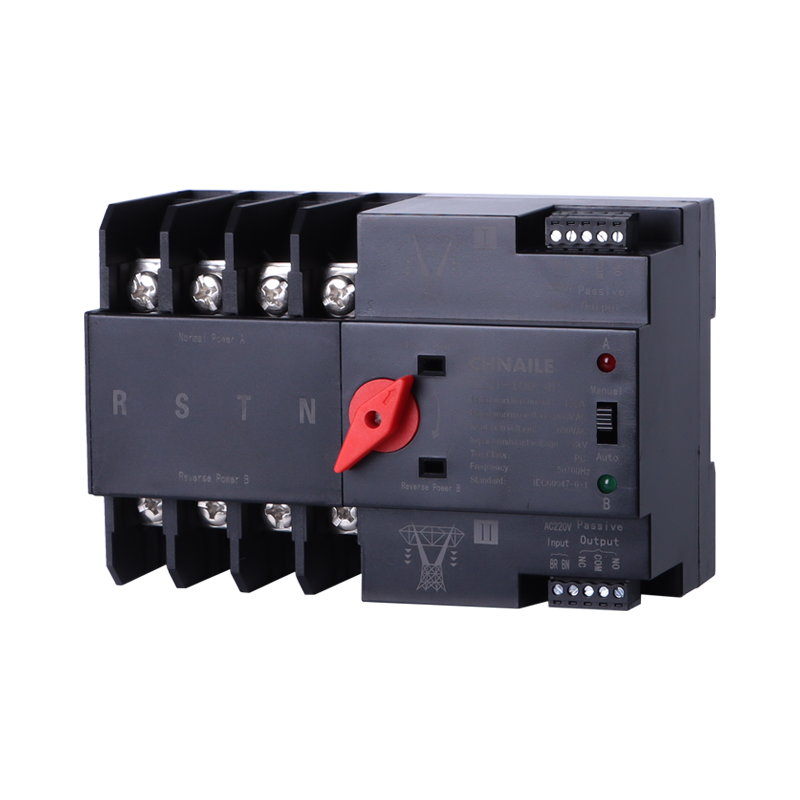
We push this parametric scalability far beyond basic pole counts, entering the realm of absolute aesthetic and functional sovereignty. If your corporate design guidelines necessitate the polymer housing to be injection-molded in a specific industrial hue to match your proprietary switchgear line, or if you require the operational toggle to be colored a specific warning shade, our manufacturing floor will execute those exact aesthetic directives. This exhaustive customization extends to the conceptualization and production of fully bespoke retail and bulk packaging, ensuring the components arrive at your assembly plant perfectly synchronized with your internal inventory logistics. Guaranteeing this immense level of personalized manufacturing whilst ensuring absolute electro-mechanical fidelity requires the abandonment of error-prone manual labor. The intricate internal switching bridges and motorized actuators of these devices are populated utilizing state-of-the-art smart automated assembly lines, ensuring absolute physical consistency across massive procurement batches. Subsequently, every custom-ordered unit must navigate a rigorous gauntlet of computerized smart inspection equipment, verifying exact switching latency and contact resistance against international baselines before export clearance. Procurement executives, chief panel designers, and switchboard fabricators seeking to eradicate generic component sourcing are highly encouraged to initiate a direct, technical dialogue with our customized production liaisons via WhatsApp at +86 15985210820. Partner directly with our smart factory to engineer absolute power resilience, aggressive cost optimization, and unparalleled proprietary branding into your global distribution boards.