Nale Electric is willing to work together with domestic and foreign merchants to create brilliance!


| Quantity: | |
Technical Parameters
| Device Category: | Air Circuit Breaker (ACB / Universal Breaker) |
| Poles Configuration: | 3P (Simultaneous 3-Phase Main Incomer) |
| Frame Current (Inm): | 3200A (Massive structural and thermal capacity) |
| Rated Current (In): | 2500A (Adjustable via intelligent controller) |
| Rated Operating Voltage (Ue): | AC 400V / 690V |
| Ultimate Breaking Capacity (Icu): | 100kA (Terrifying plasma suppression at 400V) |
| Short-Time Withstand (Icw): | 65kA for 1s (Category B Elite Selectivity) |
| Control Accessories: | Built-in AC 230V Motor Operator, Shunt Release, Closing Electromagnet |
| Installation Architecture: | Horizontal Drawout (Withdrawable Cradle) |
| Standard Compliance: | GB/T 14048.2 / IEC 60947-2 |
The Uimp = 12 kV impulse withstand voltage extends the device's dielectric performance specification into the transient overvoltage domain: the open contact gap and the housing insulation are verified by type testing to withstand a 1.2/50 µs standardised impulse of 12 kV peak without flashover or puncture, confirming the device's immunity to the lightning-coupled and switching-surge transient overvoltages that propagate through MV/LV transformer secondary networks in the utility infrastructure environments — municipal substations in East Africa, commercial building main switchrooms in the Gulf, and BESS container AC bus assemblies in solar-plus-storage installations — where this device tier is most commonly deployed. The dual working voltage rating of 400 V / 690 V further distinguishes the NLW1-3200/3 from devices calibrated exclusively for the 400/230 V TN-S residential and commercial building distribution standard: at 690 V, the device addresses industrial and heavy commercial distribution networks where higher voltage is employed to reduce bus bar current and associated conductor costs at high power levels — a voltage class encountered in large commercial building chiller plant MCC feeds, industrial process distribution in manufacturing facilities adjoining commercial developments, and the DC-to-AC conversion bus architecture of grid-scale BESS installations where the inverter output bus voltage may exceed 400 V to reduce distribution losses at high power outputs.
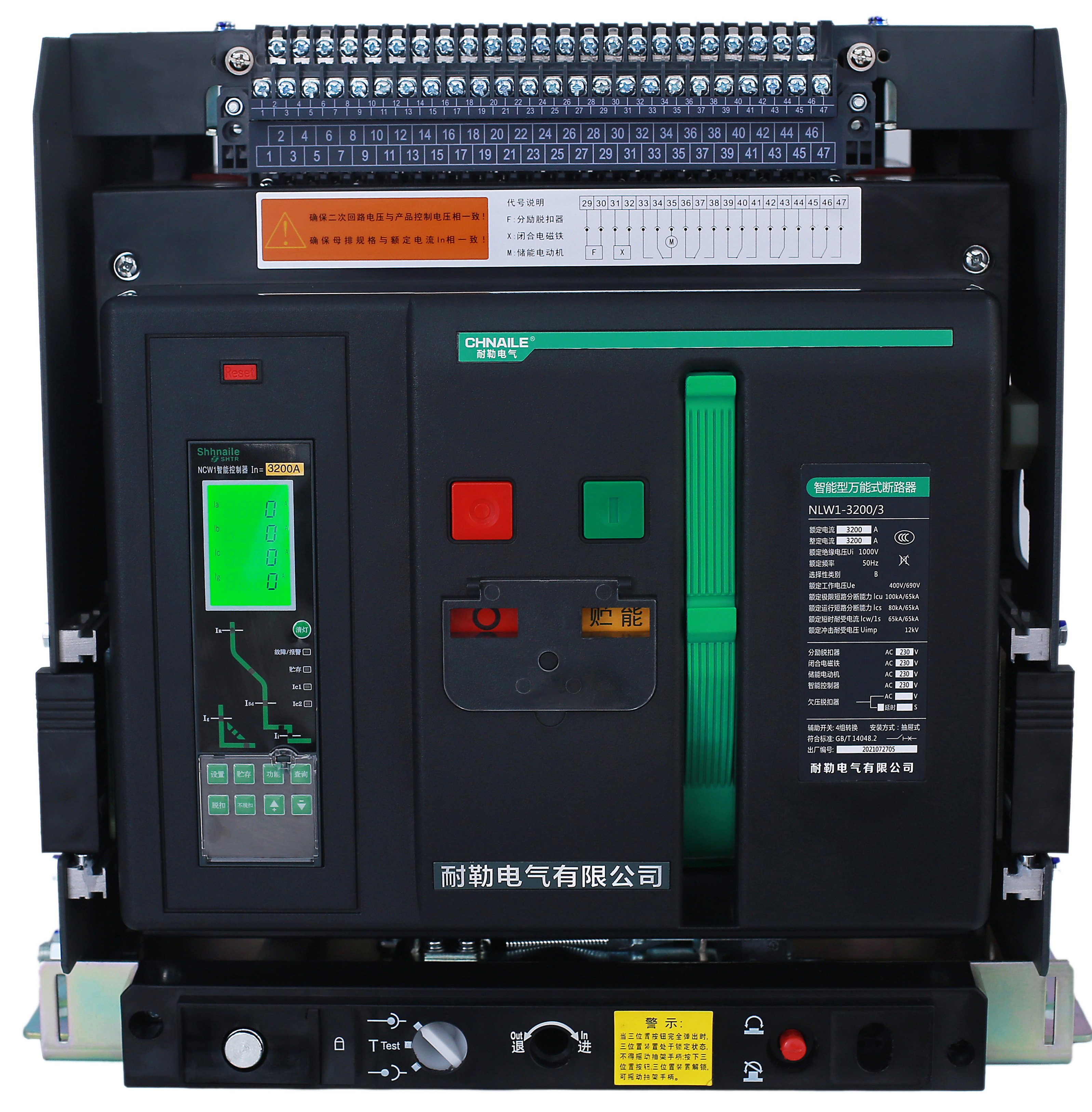
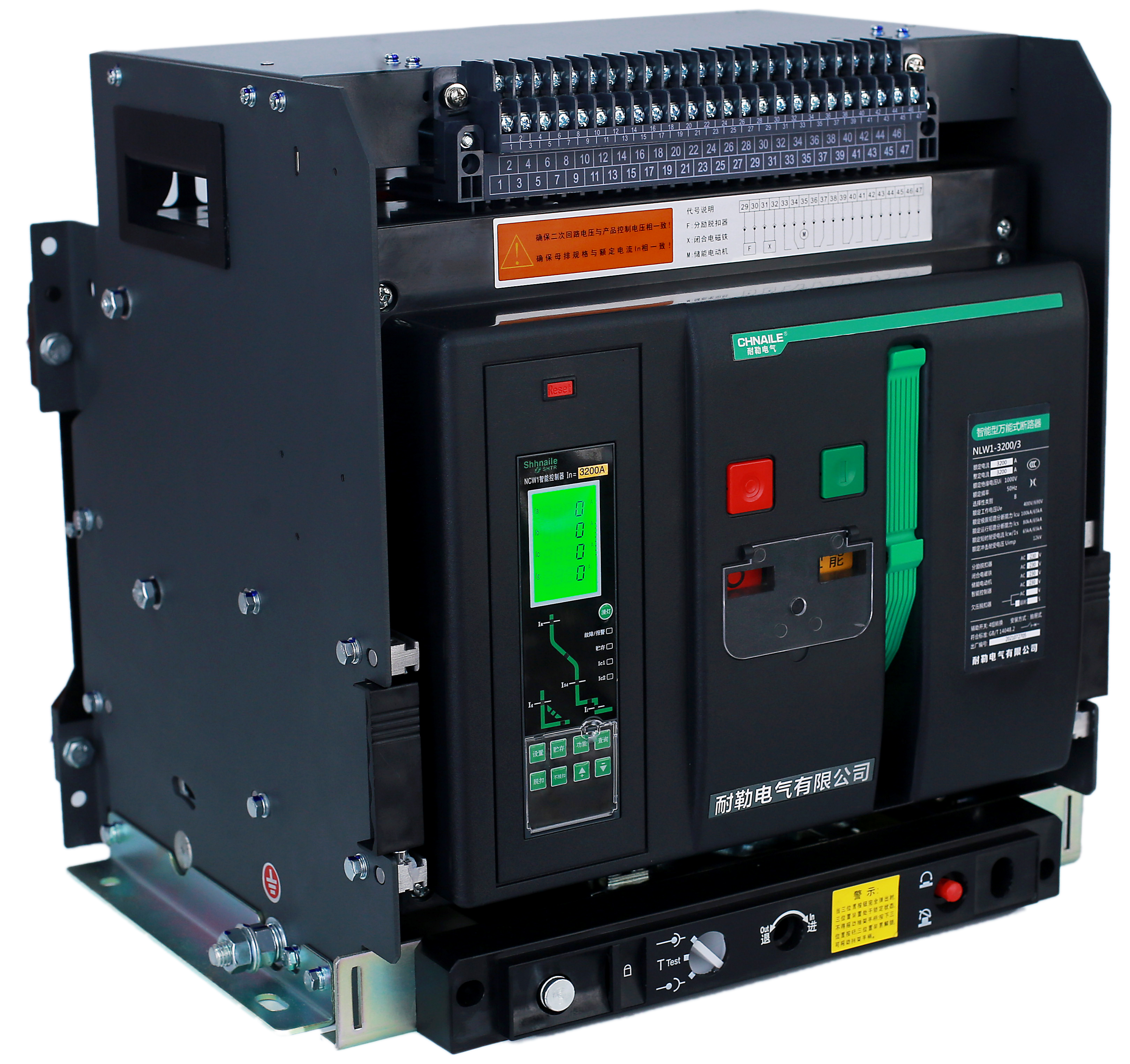
The uppermost section of the NLW1-3200/3 as presented in the product image is occupied by a 47-point auxiliary terminal block, its individual terminals numerically labelled 1 through 47 in blue-on-white legend strips, arranged in two rows across the full width of the device's top face. This terminal density is not an overengineering exercise; it is the physical interface through which the ACB integrates into the comprehensive control, monitoring, and protection wiring ecosystem of a modern intelligent switchgear panel — and its 47 positions represent a pre-engineered wiring capacity that eliminates the need for supplementary marshalling terminal rails, auxiliary relay modules, and control cable junction boxes that earlier-generation ACB designs required as external BOM additions to achieve equivalent functionality. The terminal reference legend visible in the image — identifying terminals 29 through 47 as serving the F (shunt release trip coil), X (closing electromagnetic coil), and M (stored-energy motor) circuits, with distinct column groupings that allow the panel wiring technician to identify the circuit group by position rather than by individual terminal number — reduces the wiring time and cross-connection error risk for the panel assembly technician assembling the ACB's control circuit harness. In a switchgear assembly factory wiring a main distribution board with multiple ACB positions, the structured terminal block layout of the NLW1-3200/3 translates directly into a measurable reduction in the control circuit wiring labour hours per ACB position — a labour-hour saving that, at the bill rate of an experienced switchgear wireman, compounds to a meaningful assembly cost reduction across a production run of ten or twenty identical panels. The NCW1 intelligent controller — the backlit green LCD unit visible occupying the left half of the device face, displaying the current set value of In = 3200 A in the image, with a five-row numerical readout panel showing measured phase currents and a protection characteristic curve diagram below the display — functions as both the protection parameter management interface and the real-time metering display that replaces the supplementary panel meters (ammeters, power factor meters, energy integrators) that a conventional ACB installation requires as separate panel instruments. The protection curve diagram printed on the trip unit face — showing the characteristic shape of the LISG (Long-time, Instantaneous, Short-time, Ground-fault) four-stage time-current curve — serves a commissioning reference function: the protection engineer verifying the trip unit settings against the coordination study can compare the displayed numerical set values to the characteristic curve shape and immediately identify whether the L/S coordination margin (the vertical separation between the long-time and short-time characteristics at the fault current level of interest) is consistent with the coordination study's requirement, without requiring an oscillographic test injection at each ACB position. The large red CLOSE push button and large green OPEN push button — square-format, tactile, prominently centred on the face — reflect an interface design philosophy that prioritises error-free operation under the time pressure and partial-attention conditions of a live switchgear commissioning sequence: the colour convention (red for CLOSE, green for OPEN) is the inverse of the traffic-light convention precisely because in switchgear operation, closing onto a live bus is the higher-attention action that the red designation flags, while opening (de-energising) is the return-to-safe-state action that green designates. The yellow (spring charged) indicator positioned between the two push buttons provides the mechanical status confirmation that must be verified before a CLOSE command is issued — a CLOSE attempt against an uncharged closing spring will fail, and the coloured indicator prevents this wasted operation. The full-height bright green draw-out racking lever on the right chassis face is the most visually arresting element of the device in the image: its colour (matching the OPEN push button and the brand's signature green) communicates its function — it is the safe-withdrawal tool, the element that moves the device from connected to test to disconnected position — and its length (spanning nearly the full height of the device face) provides the mechanical leverage that allows a single technician to rack a device of this mass without tools, in the confined working space of a switchgear cabinet bay.
The switchgear integrator whose project portfolio includes the highest-value contract categories — MV/LV substation secondary switchgear for municipal utility programmes, main distribution board packages for Class A commercial office tower developments, AC bus protection assemblies for multi-megawatt BESS projects, and power distribution unit assemblies for hyperscale data centre expansions — operates in a procurement environment where the ACB specification is not determined by unit price but by the intersection of three verification requirements that the project's electrical consultant and the government's inspecting authority enforce independently: the device must carry a rated short-circuit performance that covers the calculated prospective fault current at the installation point (which, at main bus incomer positions in the applications listed, routinely exceeds 50 kA), it must carry independent third-party certification from a globally recognised laboratory validating that the rated performance was measured rather than calculated, and it must be available from a supply chain whose production traceability documentation can withstand the scrutiny of a project commissioning engineer who has been contractually mandated by the end client to reject any installed component that cannot be matched to a certified design by batch record. The NLW1-3200/3 satisfies all three verification requirements through the CB Scheme certification and TUV third-party type-test report that underpin its IEC 60947-2 and GB/T 14048.2 compliance declarations — a dual-certification architecture whose commercial value to the switchgear integrator lies not in the certificates themselves but in the procurement decision simplification they enable: a project specification that names IEC 60947-2 with CB and TUV certification as the acceptance criterion for the ACB can be satisfied by the NLW1-3200/3 without requiring the project's electrical consultant to conduct an independent design review or the inspecting authority to commission supplementary testing, because the CB Scheme certificate represents an internationally portable mutual recognition agreement among IECEE member bodies that the device has been tested by an accredited laboratory and found to comply. The frame current scalability from 630 A through 8000 A across the NLW1 platform — with the 3200 A configuration presented here representing the high-capacity segment that addresses the largest commercial building incomer and municipal substation bus positions — means that the switchgear integrator qualifying our factory as an ACB supplier qualifies a platform rather than a single device, covering every ACB position in their standard product range from the sub-incomer tier (630 A to 1250 A) through the main incomer tier (1600 A to 3200 A) to the large transformer secondary bus tier (4000 A to 8000 A) within a single CB certificate scope and a single factory audit record. The 3P and 4P pole count configurability extends this platform coverage to both three-wire systems (TN-C and IT earthing configurations prevalent in certain industrial and older commercial building installations) and four-wire TN-S systems, while the manual and motorised spring-charging options address both economy-grade installations (where local manual operation is acceptable) and premium automated switchgear (where motorised operation enables remote closing, automatic bus-coupling, and SCADA-integrated load management sequences that command a significant premium in the data centre and premium commercial development markets). The optional Modbus RTU communication interface — factory-installed on customer specification — transforms the NCW1 controller from a local protection management device into a network node that reports measured currents, active protection set values, trip event timestamps, and spring-charge status to the building management system or SCADA gateway in real time, delivering the operational data transparency that energy management consultants and building certification programmes (including the LEED and BREEAM frameworks whose adoption is expanding in Gulf and European commercial development markets) increasingly require as a condition of their highest-tier ratings. Switchgear integrators, panel builders, utility procurement engineers, data centre power infrastructure managers, and EPC electrical specification teams who are evaluating the NLW1 platform for active project qualification, approved vendor list development, or private-label ACB product range establishment are encouraged to initiate a direct technical dialogue with our manufacturing team via WhatsApp at +86 15985210820, where frame rating, pole count, voltage class, breaking capacity tier, operating mechanism, communication protocol, certification documentation package, and project delivery schedule will be addressed by a dedicated export applications engineer within one working day.
 Instruction Manual for Nailer W1 Series Air Circuit Breakers.pdf


