Nale Electric is willing to work together with domestic and foreign merchants to create brilliance!


| Quantity: | |
The most technically consequential design detail of the NLB1-160 PV visible in the product image — and the one that most fundamentally distinguishes a correctly engineered DC photovoltaic circuit breaker from an AC device whose label has been relabelled with a DC voltage rating — is the alternating polarity sequence of the six main terminals: reading across the line face from left to right, the markings show −1, +3, −5 (three terminals with alternating negative and positive polarity designations), and across the load face, +2, −4, +6 (the complementary alternating sequence). This alternating arrangement is not a labelling convention or a wiring guide convenience — it is the physical encoding of the three-pole series arc extinction strategy that is the only engineering architecture capable of reliably interrupting 750 V DC fault currents at the 15 kA symmetrical breaking capacity that utility-scale and commercial PV string protection demands. The fundamental challenge of DC arc interruption — absent from the AC protection problem at the same voltage level — arises from the absence of natural current zero crossings in a DC waveform: an AC arc extinguishes naturally twice per cycle when the supply current passes through zero and the arc plasma deionises; a DC arc, driven by a constant voltage source whose current never reverses, must be forced to extinction by elongating the arc until the arc voltage (the voltage required to sustain the arc across the growing contact gap) exceeds the source voltage maintaining it. In a single-pole DC contact gap interrupting 750 V, the contact separation distance required to generate an arc voltage exceeding 750 V — at the arc currents and plasma temperatures produced by a 15 kA fault — would demand contact travel distances and housing volumes that are physically incompatible with a DIN-rail-format device. The series-connection of three poles, each contributing an arc voltage of approximately 250 V in its own contact chamber, produces a total series arc voltage of approximately 750 V from contact gaps that are individually only one-third the size that a single-pole 750 V DC device would require — enabling the NLB1-160 PV's DIN-rail-compatible housing dimensions while achieving the 750 V DC rating that the photovoltaic industry's dominant string voltage standard demands. The alternating polarity sequence — where consecutive poles see opposite current directions (current flowing from − terminal to + terminal in one pole, and from + to − in the adjacent pole) — ensures that the magnetic blowout forces generated by the current-carrying arc in each pole's arc chute act in consistently beneficial directions relative to the contact separation motion, driving the arc toward the splitter plates rather than back toward the contacts in any pole regardless of the circuit's DC polarity orientation at the instant of fault.
Parameter | Specification | Standard Reference |
|---|---|---|
Model | NLB1-160 PV C160-3P | - |
Rated Operational Voltage (Ue) | DC 750V | IEC 60947-2 |
Rated Insulation Voltage (Ui) | 6kV | IEC 60947-2 |
Rated Current (In) | 160A | IEC 60947-2 |
Ultimate Short-Circuit Breaking Capacity (Icu) | 15kA | IEC 60947-2 |
Service Short-Circuit Breaking Capacity (Ics) | 15kA (Ics = Icu) | IEC 60947-2 |
Number of Poles | 3P | - |
Trip Characteristic | C curve | IEC 60947-2 |
Utilization Category | CAT. A | IEC 60947-2 |
Compliance Standards | GB/T 14048.2, IEC 60947-2 | - |
Brand | CHNAILE | - |
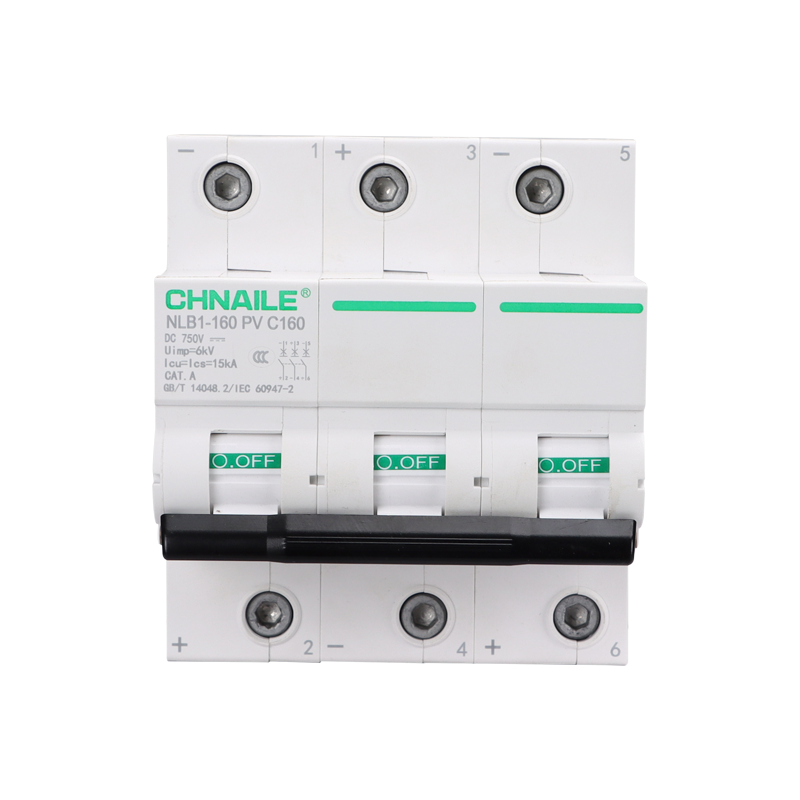 | 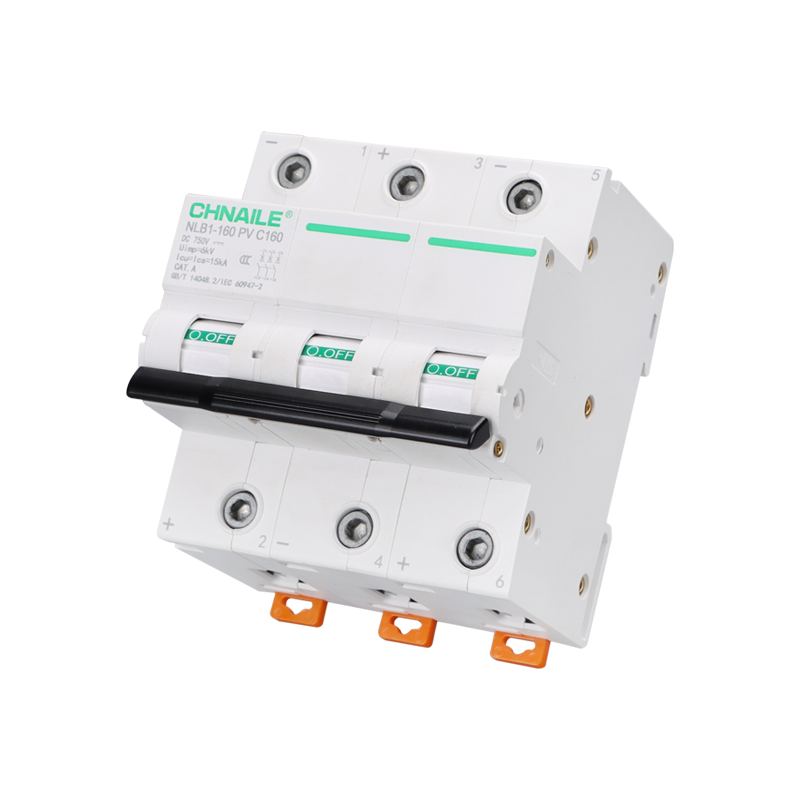 | 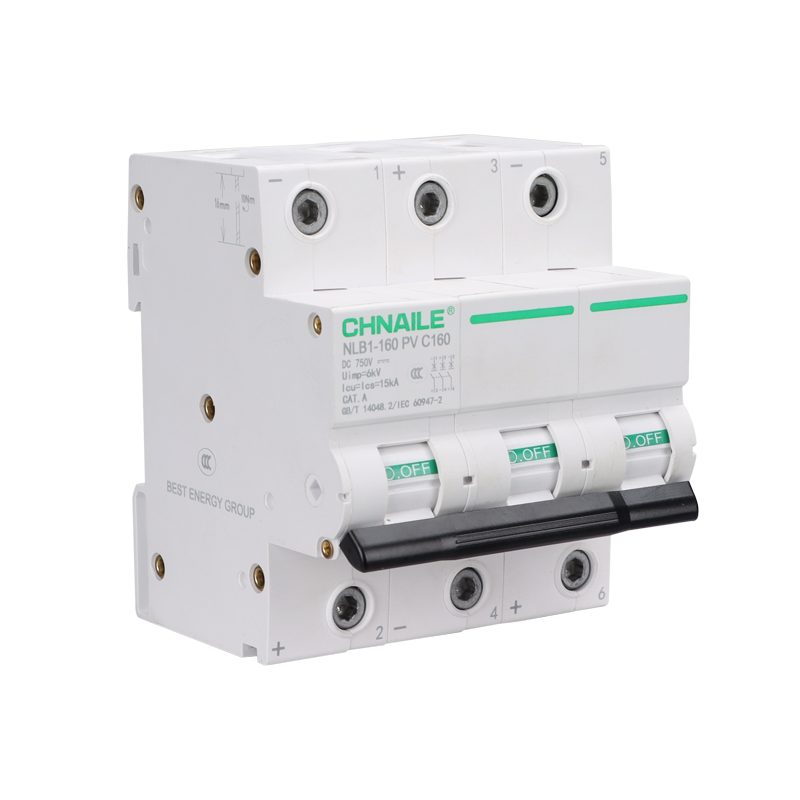 |
The black unified spanning actuator bar bridging all three individual pole handles — visible in the image as a continuous black element traversing the lower section of all three toggle handles simultaneously — enforces the mechanical simultaneity of three-pole contact opening and closure that the series-arc extinction strategy requires. If one pole's contacts open before the others, the full 750 V DC source voltage appears across the gap of the first-opening pole alone, requiring that pole to interrupt the full system voltage rather than its one-third share — a condition that may exceed the single-pole's dielectric withstand capability and produce a restrike arc that re-energises the fault current path. The simultaneous opening enforced by the unified actuator bar prevents this asymmetric voltage distribution by ensuring that all three contact gaps begin separating within the same millisecond, so that the total arc voltage builds across all three poles simultaneously from the first instant of contact separation. The individual O·OFF labelled toggle handles on each pole — visible as three separate white actuator elements each displaying "O·OFF" text within their respective pole channels — provide the per-pole mechanical position reference that maintenance technicians require when verifying the device's isolation state, while the unified actuator bar ensures that attempting to manually operate any single pole handle drives all three poles simultaneously, preventing the inadvertent single-pole opening that would impose the full system voltage across one contact gap during manual switching.
The dual standard compliance declaration of the NLB1-160 PV — GB/T 14048.2 and IEC 60947-2 simultaneously, with CCC certification — positions this device at the intersection of two rapidly converging procurement environments: the Chinese domestic new energy project market, where government-funded utility-scale solar and BESS installations are governed by GB standards and require CCC-marked components as a condition of grid connection approval; and the international PV project market, where IEC 60947-2 is the governing standard referenced by equipment approval bodies in the Gulf, East Africa, Southeast Asia, and the Latin American markets whose solar installation capacity is expanding at the fastest rates in the global new energy sector. For the PV combiner box manufacturer and the solar system integrator whose project pipeline spans both domestic and export markets within the same production year, the ability to source a single DC PV MCB specification that satisfies both the GB/T 14048.2 / CCC pathway for domestic Chinese-standard project submissions and the IEC 60947-2 / CE or CB pathway for international project equipment approval eliminates the component differentiation overhead — separate qualification records, separate type-test documentation, separate procurement streams — that a two-specification approach would impose. The Category A classification marked on the device's label reflects the IEC 60947-2 and GB/T 14048.2 requirement that the device achieve its rated breaking capacity without requiring a specific recovery test sequence — a performance standard whose practical consequence for the PV system integrator is that the NLB1-160 PV can be specified for string combiner box positions where the post-fault restoration of the protected string requires the protective device to return immediately to service after fault clearance, without mandating a visual inspection or contact replacement interval between the fault event and the re-energisation of the string. In utility-scale solar installations with hundreds or thousands of string combiner positions, this Category A service resumption capability — the ability to remotely re-energise a tripped string after a transient fault without dispatching a maintenance crew to replace or inspect the protective device — is an operational cost reduction whose value over the installation's twenty-five-year design life is substantially larger than the unit price differential between a Category A and a Category B device at the same current rating.
he Uimp = 6 kV impulse withstand voltage — marked on the label alongside the DC 750 V operational rating — addresses the transient overvoltage environment specific to PV array installations, where lightning-coupled transients from the array field's extensive cable network can impose voltage spikes that far exceed the nominal DC bus voltage at the combiner box terminals. In a large commercial rooftop PV installation or a utility-scale ground-mount array where the DC cable runs from the string panels to the combiner box span distances of 50–200 metres, the inductance and capacitance of the cable network amplifies lightning-coupled transients to peak values that may reach 2–4 times the nominal DC bus voltage at the combiner box input terminals. The NLB1-160 PV's 6 kV Uimp provides the dielectric withstand margin that maintains the device's insulation integrity through these transient events without puncture, ensuring that a lightning strike on the array field does not destroy the protective device at the combiner box and leave the associated strings without overcurrent protection until the next maintenance visit.
The commercial-scale solar-plus-storage project — a rooftop or ground-mount PV installation with 500 kW to 5 MW of panel capacity combined with a 500 kWh to 5 MWh BESS — generates a DC component bill of materials whose protective device population spans three distinct current tiers and two functional categories, and whose sourcing from a single qualified DC MCB manufacturer produces procurement efficiencies that are structurally impossible when each tier is sourced from a separate supplier. The three current tiers are: the string-level protection tier (typically 10–25 A per string, where the short-circuit current of a single PV string determines the protective device rating), the sub-array combiner protection tier (typically 40–100 A, where groups of 4–8 strings are combined before feeding the inverter DC input), and the inverter DC input protection tier (typically 100–160 A per inverter DC input, where the NLB1-160 PV's 160 A rating addresses the largest string inverters in the 50–75 kW range). Our NLB1 PV platform's rated current configurability from 6 A through 160 A covers all three tiers within a single product family, allowing the PV system integrator or combiner box manufacturer to specify a single supplier, submit a single type-test documentation package for the project's equipment approval process, and manage a single delivery logistics relationship rather than coordinating three separate suppliers whose lead times, quality documentation formats, and commercial terms must all be aligned before the project's combiner box assembly can begin. The DC voltage configurability — with the 750 V standard configuration addressing the dominant IEC-standard string voltage for 60-cell and 72-cell monocrystalline panel configurations at typical operating conditions, and higher voltage configurations available for 1000 V DC and 1500 V DC string architectures used in utility-scale ground-mount systems — extends this single-supplier coverage to the full voltage spectrum of the commercial and utility PV market without requiring the integrator to qualify a separate product family for each DC voltage tier. For BESS DC bus protection applications — where the battery string voltage in lithium iron phosphate (LFP) and NMC chemistry systems for commercial-scale storage typically spans 400–800 V DC at the string level and the protective device must interrupt DC fault currents whose magnitude is determined by the battery pack's internal impedance rather than a current-limited photovoltaic source — the NLB1-160 PV's series-arc extinction architecture and 750 V DC rating provide the protective device specification that covers the majority of commercial BESS string voltage configurations without the additional design complexity of a purpose-built battery protection device at a premium unit cost. PV combiner box manufacturers, solar system integrators, BESS panel assemblers, new energy project EPC electrical engineers, and utility procurement managers evaluating the NLB1-160 PV platform for string, sub-array, or inverter input DC protection applications are encouraged to initiate a direct technical dialogue with our manufacturing team via WhatsApp at +86 15985210820, where rated current, DC voltage level, pole count, housing colour, certification documentation requirements, and project volume parameters will be addressed by a new energy applications engineer returning a complete technical and commercial proposal within one working business day.


