Nale Electric is willing to work together with domestic and foreign merchants to create brilliance!


| Quantity: | |
The coiled neutral pigtail lead visible in the product image — a feature that immediately distinguishes the NLRO-40L from the screw-terminal DIN rail RCBO architectures that dominate European and IEC-format distribution board markets — is not merely a wiring convenience; it is the physical encoding of a specific panelboard installation standard that has been embedded into the residential and commercial electrical construction practices of North America and significant portions of Latin America for several decades, and whose adoption by the load-centre panel manufacturers whose chassis designs define the physical envelope into which this breaker must fit has made the pigtail neutral connection the only architecturally compatible interface for an RCBO (or GFCI circuit breaker, in the terminology used by the North American electrical trade) installed in a residential or light-commercial load centre. The load-centre panel design — characterised by a central neutral bus bar, stab-in breaker connection to the hot bus bar, and a dedicated wiring channel that routes the neutral pigtail from the breaker body to the neutral bus — does not provide a neutral screw terminal on the breaker mounting position, because the neutral current return path for a GFCI/RCBO-protected circuit must pass through the breaker's internal current transformer rather than connecting directly to the neutral bus: the RCBO's ground-fault detection function requires that both the line current and the neutral current for the protected circuit pass through the device's toroidal sensing transformer, so that any imbalance between them — representing current leaking to earth through an unintended ground path — can be detected and used to initiate trip actuation. A screw-terminal breaker design, connecting the load-side neutral directly to a terminal on the breaker body, achieves this topology; the pigtail design achieves the same topology by routing the load-side neutral through a lead that exits the breaker body and is connected by the installer to the neutral bus, while the line-side and load-side line connections are made through the stab-in bus connection and the load terminal screw respectively. The coiled retractile format of the pigtail — observable in the image as a tightly wound spiral that extends to approximately twice the breaker height when relaxed and compresses into the panel wiring channel during installation — accommodates the variable routing distance between the breaker position and the neutral bus bar across different load-centre panel sizes and breaker slot positions without requiring the installer to cut the lead to length, a time-saving feature in the panel wiring sequence whose significance is amplified when a panel builder or electrical contractor is installing GFCI breakers across multiple circuits in a residential sub-panel or a commercial tenant panelboard.
Core Technical Specifications
| Brand: | CHNAILE |
| Model: | NLRO-40L |
| Device Category: | RCBO (Residual Current Circuit Breaker with Overcurrent Protection / GFCI) |
| Number of Poles: | 1P (Single Pole) |
| Rated Operating Voltage (Ue): | AC 110/240V |
| Rated Frequency: | 60Hz |
| Rated Current (In): | 20A (Curve C) |
| Residual Operating Current (I∆n): | 30mA (Life-saving grade) |
| Rated Breaking Capacity (Icu): | 6000A (6kA) |
| Compliance Standard: | IEC 61009 |
| Wiring Configuration: | Plug-in mounting with a Single Coiled Neutral Pigtail |
The parameter label visible on the NLRO-40L's face — reading, in the partially rotated orientation observable in the product image: NLRO-40L, CE, 30mA, 6000A, 60Hz, AC 110/120V, IEC61009 — establishes the device's full compliance identity for the target markets in a single glance. The AC 110/120V voltage rating confirms calibration for the dominant single-phase consumer voltage standard across North America (120 V nominal in the United States and Canada, 110–115 V nominal in Mexico and most of Central America, with significant portions of northern South America operating at 110–120 V as well). The 60 Hz frequency designation is the complementary market identifier, distinguishing this device from the 50 Hz IEC market devices that constitute the majority of our product range and confirming that the device's thermal-magnetic overcurrent calibration, the toroidal transformer's impedance characteristics, and the electronic processing in the residual current detection circuit have all been optimised for 60 Hz supply waveforms rather than 50 Hz — a distinction that matters because the half-cycle integration time of the residual current detection circuit must be matched to the supply frequency to achieve the specified tripping time of t ≤ 0.1 s across the full residual current range from IΔn to 5 × IΔn. The IΔn = 30 mA residual sensitivity is the personal protection threshold established by both IEC 61009-1 and the North American electrical safety frameworks as the maximum sustained ground-fault current compatible with personnel safety under normal physiological conditions, corresponding to the threshold below which the probability of cardiac fibrillation during a hand-to-foot current path exposure is statistically acceptable for the general population. The 6000 A breaking capacity positions the NLRO-40L correctly for the fault current levels present at the branch circuit position in residential and light-commercial load-centre panels fed by the 100 A to 200 A service entrance equipment typical of North American residential construction, where the available short-circuit current at the branch circuit terminals has been attenuated by the service entrance cable impedance, the main breaker, and the bus bar distribution to a value that, in the overwhelming majority of residential installations, remains well within the 6 kA envelope.
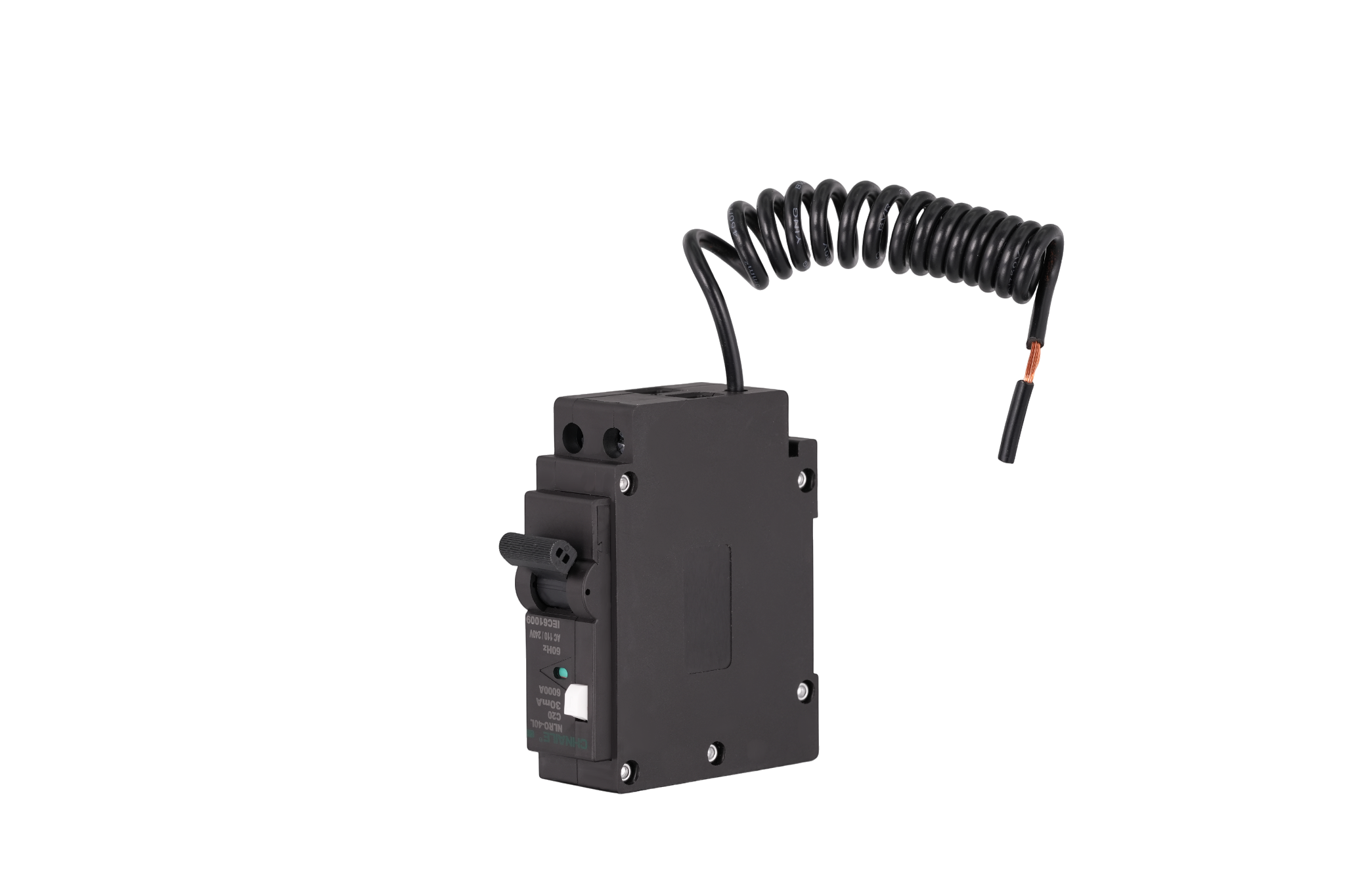
The matte-black housing of the NLRO-40L — visible as a uniform dark finish across the entire rectangular body, contrasting with the bare-copper pigtail lead and the white/green face elements — is a deliberate departure from the beige and off-white colour conventions of standard thermal-magnetic breakers, and it serves a functional purpose that experienced panel builders and electrical contractors recognise immediately: it provides the visual differentiation cue that allows a homeowner, building facilities manager, or service electrician to identify the GFCI/RCBO-protected circuit positions within the panel at a glance, without requiring label reading or circuit directory consultation. In a residential load centre populated with twenty or thirty standard breakers and four or six GFCI positions, the black housing of the NLRO-40L creates an unambiguous visual hierarchy that communicates "this circuit has ground-fault protection" to any observer familiar with the convention — a convention that, once established through consistent use across a panel builder's or electrical contractor's installations, becomes a self-documenting quality signal that reduces service call frequency by enabling property maintenance personnel to correctly identify and test the GFCI breakers during routine monthly testing without professional guidance. The white test button, positioned on the device face and visible in the product image as a recessed rectangular push surface contrasting against the dark housing, executes the IEC 61009-1 mandated periodic functional verification by inserting a calibrated impedance into the residual current measurement circuit, simulating a 30 mA ground fault without the presence of an actual fault condition and confirming that the detection-to-trip chain is operationally intact. The green LED indicator — a small but highly visible element on the face, observable in the image — provides closed-contact status confirmation without requiring the installer or maintenance technician to measure voltage at the load terminals, reducing the time required for post-installation circuit verification and eliminating the need for a supplementary panel position indicator accessory. The black toggle actuator lever, mounted on the left face of the housing with a positive detent at both the ON and tripped positions, provides tactile and visual trip-state confirmation: the lever position difference between ON and tripped is sufficient to be readable by physical touch in the dark conditions of a panel cabinet accessed without a torch, a safety-relevant detail in residential maintenance scenarios.
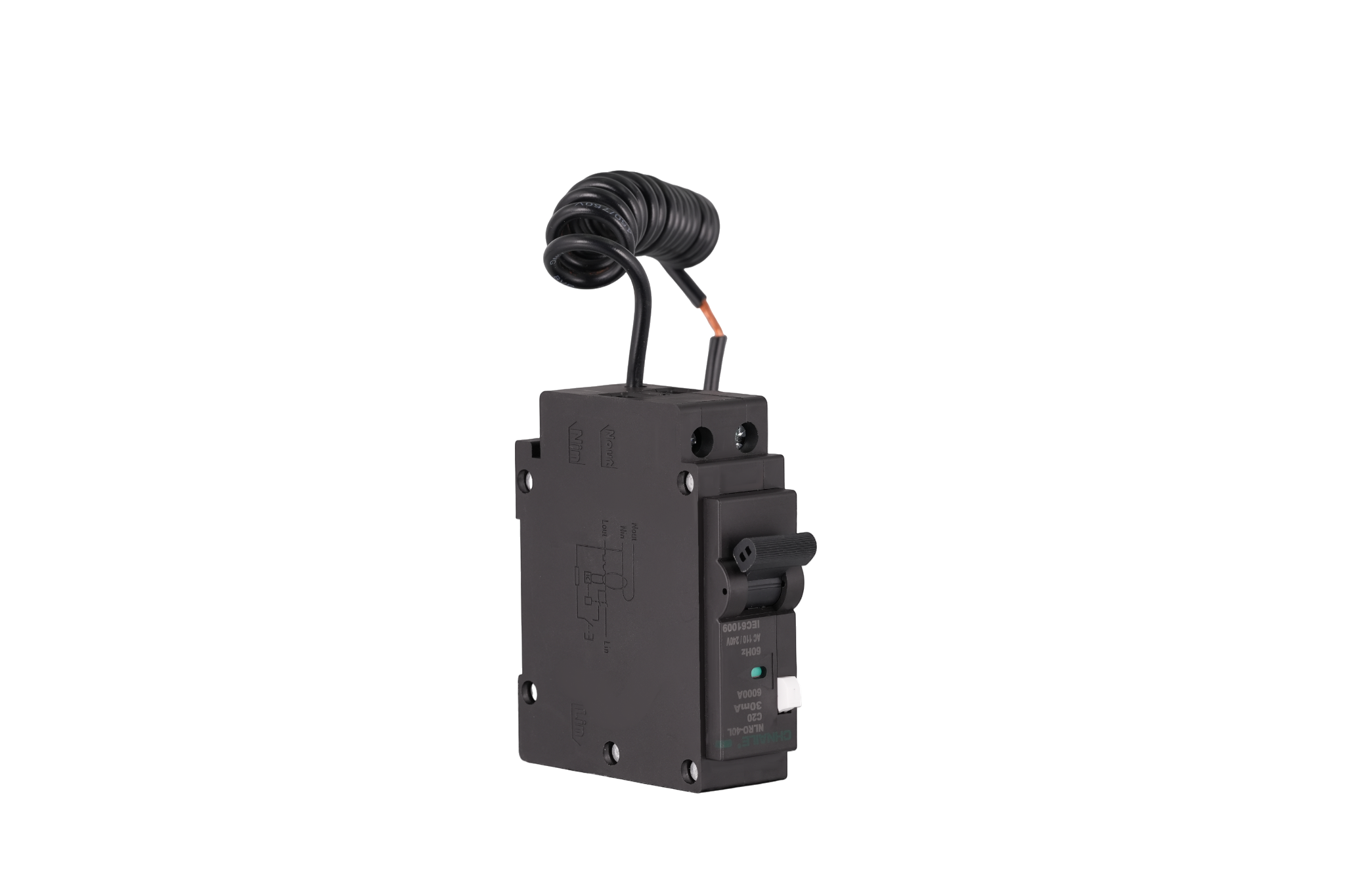
The commercial operating model of electrical product distributors serving the North American and Latin American residential electrical market differs structurally from the European panel builder model in one critical dimension: the distributor maintains a ready-stock inventory that must cover the full ampacity range of the residential branch circuit spectrum — 15 A for lighting and small appliance circuits, 20 A for kitchen and bathroom circuits, 30 A for dryer and water heater circuits, 40 A for larger cooking appliance circuits, 50 A and 60 A for electric vehicle charging and air conditioning equipment — because the electrician or contractor purchasing from the distributor expects same-day fulfilment from stock rather than a project-lead-time delivery. The inventory carrying cost of maintaining this full ampacity range in a pigtail RCBO/GFCI format across both 10 mA (enhanced sensitivity for medical-adjacent applications) and 30 mA (standard personal protection) sensitivity variants, from a supply chain dependent on multiple manufacturers for different current tiers, is the principal margin erosion mechanism in the distribution of residential electrical protection devices. Our NLRO series manufacturing platform addresses this carrying-cost problem through amplitude-scalable production across a single form-factor: the pigtail neutral configuration, the housing dimensions, the mounting geometry, and the installation interface are identical from the 15 A variant through the 60 A variant, meaning that a distributor qualifying our platform qualifies a single physical product type that differentiates only by the current-rating label, the thermal element calibration, and the load terminal screw rating — three parameters that are set during our automated production process rather than requiring separate component inventory management at the distributor's warehouse. The housing colour — presented in the matte-black finish visible in the product image — is configurable for OEM customers whose private-label product strategy or regional market convention specifies a different housing standard, a customisation that our injection moulding process accommodates at agreed OEM volumes without requiring a dedicated tooling investment from the customer. For electrical contractors and residential panel builders operating in Latin American markets where 60 Hz / 110–120 V infrastructure is expanding through urban electrification programmes in Colombia, Peru, Ecuador, and Central America — markets where locally manufactured GFCI breakers carry a trusted-brand premium that a Chinese-sourced private-label product has historically been unable to command — the IEC 61009-1 certification and CE marking of the NLRO-40L, combined with the option for private-label housing and packaging under the contractor's or distributor's own brand identity, creates the conditions for a market positioning argument that is no longer about price parity but about specification equivalence: the same IEC standard, the same 30 mA threshold, the same 6 kA breaking capacity, under a brand name the customer controls and a supply price that preserves the margin to invest in market development. Electrical product distributors, residential panel builders, commercial electrical contractors, PV sub-panel integrators, and BESS AC distribution board assemblers operating in North American-standard markets who are evaluating the NLRO series platform for inventory qualification, private-label product development, or project-specific supply are encouraged to initiate a direct technical dialogue with our manufacturing team via WhatsApp at +86 15985210820, where ampacity range, sensitivity, housing colour, packaging format, and volume parameters will be addressed by an export applications engineer returning a complete commercial and technical proposal within one working day.


