Nale Electric is willing to work together with domestic and foreign merchants to create brilliance!


| Quantity: | |
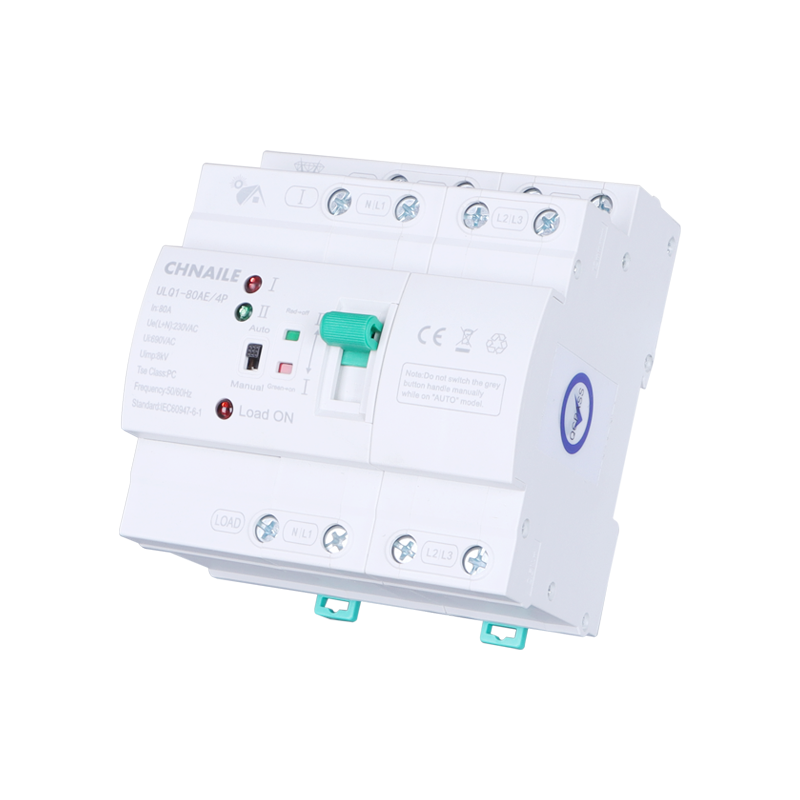
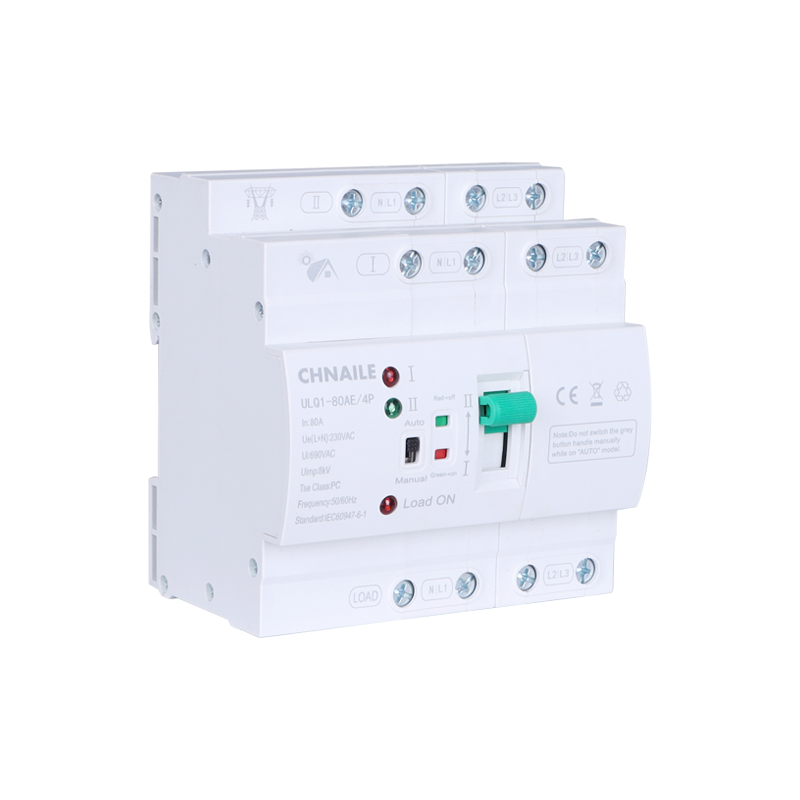
The front face of the ULQ1-80AE/4P is, for a practised panel engineer, a compressed risk-management dossier rather than a simple product label. Reading systematically from the upper-left parameter block: In = 80 A establishes the device's continuous current rating — the maximum sustained load current that the transfer switch's contact system is designed to carry without accumulating thermal degradation beyond the IEC 60947-6-1 endurance limit; Un(L+N) = 230 VAC designates the rated operational voltage referenced to line-to-neutral, confirming the device's native calibration for the 230/400 V three-phase four-wire TN-S networks that constitute the distribution standard across the European Union, the Gulf Cooperation Council's utility grids, and the majority of sub-Saharan Africa's commercial infrastructure; Ui = 690 VAC specifies the rated insulation voltage — a parameter that defines the maximum voltage the device's inter-phase and phase-to-earth insulation geometry is designed to withstand continuously without dielectric failure, a value significantly above the operational voltage to provide the creepage and clearance margin that IEC 60947-1 mandates for pollution degree 3 environments, the contamination category applicable to industrial switchroom conditions; and Uimp = 8 kV records the rated impulse withstand voltage, the peak kilovolt value of a standardised 1.2/50 µs impulse that the device's insulation must survive without puncture — a parameter that, in practical deployment terms, determines the device's immunity to the transient overvoltages generated by lightning coupling into the low-voltage network, load-switching transients from large inductive plant, and the switching surges produced by upstream ACB or MCCB operation in the incomer position. The Tac Class PC designation — visible in the parameter list and directly meaningful to engineers familiar with IEC 60947-6--1's equipment classification structure — identifies this device as a transfer switch capable of making and breaking load current under both normal conditions and defined abnormal conditions, distinguishing it from the simpler Class CB category (which relies on an integrated circuit-breaker mechanism for interruption) and confirming that the ULQ1-80AE/4P's contact system is independently rated for the transition event itself, not merely for continuous conduction. For commercial building backup power systems — where the transfer event between utility supply and generator supply must be completed within a defined time window to maintain continuity for critical loads such as fire safety systems, emergency lighting, data centre UPS charging circuits, and elevator safety circuits — this Class PC architecture is the correct specification, and it is the specification that building electrical inspectors in IEC-governed jurisdictions will check first when reviewing a transfer switch installation for code compliance.
The status indication and control architecture visible on the ULQ1-80AE/4P's front panel represents a resolved engineering answer to a specific operational problem: the ambiguity that arises during transfer events when a maintenance technician, standing at a distribution board under time pressure, cannot determine at a glance whether the source changeover has completed, which source is currently energised, and whether the load circuit is receiving power. The three-LED indicator cluster — configured, as observed in the product image, in a vertical column on the left side of the device face, with the upper red LED labelled for Source I status, the middle green LED for Source II status, and the lower red indicator marked Load ON — eliminates this ambiguity through a colour-coded real-time status display that is readable from panel door distance and interpretable without consulting a wiring diagram or a commissioning manual. The Load ON indicator in particular serves a safety-critical function: in a Class PC transfer switch installed in a dual-source commercial building distribution board, a technician isolating the board for maintenance work must be able to confirm, before touching any terminal, that the load circuit is de-energised — a confirmation that requires knowing not just which source is live but whether the transfer switch has successfully routed that source to the load terminals. A dedicated, unambiguous Load ON indicator directly addresses this requirement and, in doing so, reduces the minimum time required for a safe isolation procedure to a single visual check rather than a multi-step voltage-testing sequence. The Auto/Manual selector toggle, positioned centrally on the device face with explicit text labelling, controls the device's operating mode in a manner that is directly consequential for commissioning workflow: in Auto mode, the internal voltage-sensing relay monitors both source terminals continuously and initiates a transfer sequence autonomously when the primary source voltage drops below or rises above the preset threshold — a self-governing capability that is the entire operational rationale of an automatic transfer switch in an unattended commercial building plant room. The teal-green manual actuator handle, visible on the right side of the device face and fitted with a sliding window that exposes the I/II position indicator markings, provides the override path for commissioning, maintenance testing, and emergency manual operation when the automatic control circuit is under service. The panel caution note visible in the image — "Do not switch the grey button handle manually while on AUTO mode" — reflects a mechanical interlock design principle that prevents simultaneous engagement of the automatic drive mechanism and the manual handle, a protection that prevents contact damage that would otherwise result from operating the manual actuator against a motorised drive under load. Collectively, these interface elements reduce the commissioning technician's reliance on supplementary test instruments during initial energisation, shorten the sign-off inspection checklist, and produce a board that the site electrical engineer can demonstrate to a client representative with a direct visual narrative rather than a verbal explanation — a workflow advantage that experienced panel builders consistently cite as a differentiator in high-pressure project delivery environments.
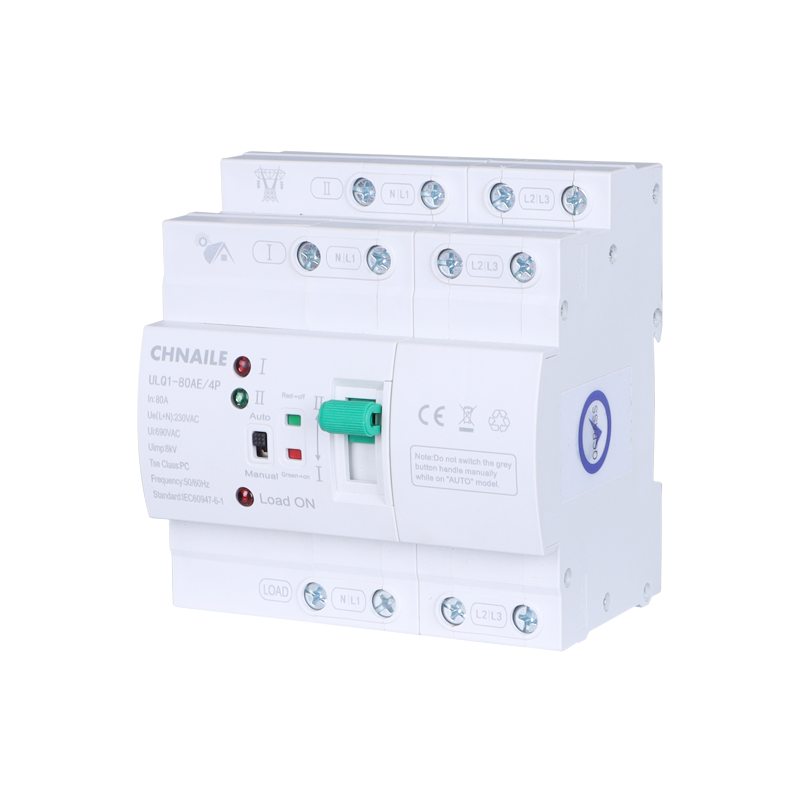
The procurement challenge that defines the ATS sourcing decision for panel builders assembling distribution boards across multiple project types is not, in most cases, the unit specification of any individual device — it is the proliferation of qualified vendor relationships, approval documentation packages, and inventory SKUs that arises when 2-pole and 4-pole transfer switches are sourced from different manufacturers because the initially approved vendor only offers one pole configuration in the required current range. The ULQ1-80AE platform resolves this rationalisation problem at the product architecture level: the same electromechanical platform, the same IEC 60947-6-1 type-test foundation, and the same factory quality process are the basis for both the 4P configuration reviewed here and a 2P variant that addresses single-phase transfer applications — commercial building tenant supply changeover circuits, single-phase generator output transfer in smaller installations, and the AC coupling transfer function in single-phase BESS architectures feeding residential or light-commercial storage systems. Maintaining both configurations within a single vendor qualification relationship means that a panel builder's procurement manager maintains one set of factory audit records, one set of type-test certificates, one supplier quality agreement, and one pricing structure covering the full pole population of their ATS BOM — a consolidation that, across a project portfolio of twenty or thirty switchgear deliveries per year, produces a measurable reduction in procurement administrative overhead and a corresponding reduction in the per-panel compliance documentation cost. The rated current, additionally, is not fixed at 80 A for OEM supply: the manufacturing platform supports current configurations across the range appropriate to the Class PC architecture, allowing a panel builder whose project portfolio spans small commercial tenant boards (requiring lower-rated ATS devices) through large commercial building main distribution boards (requiring devices at or above the 80 A level) to specify a single product family with current-differentiated configurations rather than maintaining separate product qualifications for each current tier. The customisation architecture extends beyond electrical parameters into the physical and commercial dimensions that determine whether a panel builder's finished product can command a premium price point in a competitive market. Housing colour — presented in the clean white finish visible in the product image, which was selected for its compatibility with the visual conventions of premium commercial electrical switchgear and its readability of label text under the fluorescent lighting typical of plant rooms and distribution board enclosures — is reconfigurable for OEM customers whose brand identity or market conventions specify a different housing standard. Private-label face marking, replacing the CHNAILE brand designation with the OEM customer's own brand name and model series, transforms the device from a factory-branded commodity into a branded component of the panel builder's own product catalogue — a transformation whose commercial value, in markets where the panel builder is competing for contracts on the basis of a branded product specification rather than a commodity price comparison, substantially exceeds the incremental cost of the labelling process. Packaging, from the individual unit carton through the project-quantity master carton, is similarly configurable to carry the OEM customer's branding, making the entire supply chain presentation — from factory shipment documentation through to the electrician's on-site box — consistent with the panel builder's commercial identity.
The regulatory context within which automatic transfer switches are installed and inspected has tightened substantially across the primary markets for commercial electrical infrastructure in the period following the adoption of IEC 60947-6-1 as the reference standard by national bodies in the Gulf, East Africa, and the larger Latin American economies. Municipal infrastructure procurement programmes — covering hospitals, government office buildings, water treatment facilities, and telecommunications infrastructure — now routinely require that transfer switch components be traceable to a named type-tested product, with the type-test report available for inspection by the project's commissioning engineer and, in some jurisdictions, submitted as part of the building permit application. An automatic transfer switch bearing CE marking, as the ULQ1-80AE/4P does, demonstrates conformity with the Low Voltage Directive and the Electromagnetic Compatibility Directive — a declaration that, when backed by a third-party type-test report from an accredited laboratory and a factory production control record that demonstrates the production unit's conformity with the tested design, constitutes the evidentiary basis for regulatory approval in the overwhelming majority of IEC-governed markets. Our manufacturing process produces this evidentiary chain as a standard output, not an optional premium: every production batch is processed through machine-vision-assisted assembly verification that checks component placement, terminal torque, and contact alignment against the design specification before the housing is closed; every unit passes through an automated functional test station that verifies Auto/Manual mode switching response, LED indicator operation under simulated source and load conditions, and insulation resistance between all terminal pairs before the device is released to the shipping area; and batch records are archived against a production lot number that is marked on the master carton and traceable to the raw material intake records for every critical subcomponent. Panel builders whose project contracts require them to submit a component quality traceability package as part of the as-built documentation — a condition now attached to many government infrastructure and data centre fitout contracts in the Gulf, East Africa, and Southeast Asia — can request this documentation package as part of the standard OEM supply agreement, without the time and cost penalty of commissioning a third-party factory audit from a vendor who is, in reality, a trading company with no production records of their own to disclose. Engineering managers, procurement directors, and project electrical engineers who wish to review our IEC 60947-6-1 type-test certificate, request configuration samples for pre-qualification testing, or open a formal OEM quotation discussion covering rated current, pole count, voltage marking, housing colour, and packaging format, are encouraged to initiate a direct technical dialogue with our manufacturing team via WhatsApp at +86 15985210820.